

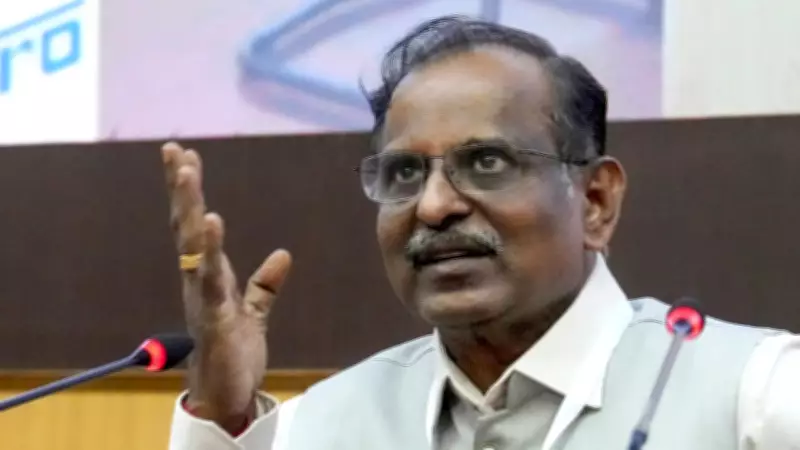
ISRO Chairman Outlines Ambitious Space Exploration Timeline for India
In a significant announcement from New Delhi, ISRO Chairman V. Narayanan has detailed the Indian Space Research Organisation's forthcoming exploration objectives, headlined by the pioneering Gaganyaan human spaceflight initiative scheduled for 2027. Additionally, the space agency is targeting two landmark crewed lunar missions—Chandrayaan-4 and Chandrayaan-5—for potential launch in 2028, contingent upon all developmental milestones being achieved as planned.
Gaganyaan Program: A Three-Phase Approach to Human Spaceflight
Narayanan emphasized that these critical missions are advancing under what he described as the "visionary leadership of Prime Minister Narendra Modi." The Gaganyaan program will follow a carefully structured path, beginning with three uncrewed test flights before the historic moment of sending Indian astronauts into space. "With the visionary leadership of PM Modi, we are working on the Gaganyaan program targeted for 2027," Narayanan stated. "Three uncrewed missions are to happen, and we are working towards them."
While the precise date for the inaugural uncrewed mission remains under finalization, the chairman confirmed that all associated development activities are progressing actively and systematically.

Crewed Lunar Missions: Chandrayaan-4 and Chandrayaan-5 on the Horizon
The ISRO chief provided clarity on the lunar ambitions, confirming that both Chandrayaan-4 and Chandrayaan-5 are formally approved programs and are advancing in alignment with their established targets. "Chandrayaan-4 and Chandrayaan-5 are both crewed missions, and if everything goes as per plan, it will happen by 2028," he elaborated, underscoring the organization's commitment to expanding India's footprint on the Moon with human presence.
Technological Advancements and Strategic Focus
Beyond crewed missions, Narayanan highlighted ISRO's parallel focus on developing reusable launch vehicle (RLV) technology, a crucial innovation aimed at enhancing the cost-effectiveness and sustainability of space missions. "We have only an experimental program right now, and we are working towards that," he noted, indicating ongoing research and development in this transformative area.
When questioned about potential comparisons with global entities like SpaceX, the ISRO chairman firmly articulated India's distinct strategic orientation. "We don't consider this as competition with anybody because the Indian space program is meant for India," Narayanan asserted. "Strength only respects strength. If you don't have a vibrant space program, no one will support you."
Driving Economic Growth and Societal Benefits
Narayanan reinforced that ISRO's endeavors are fundamentally designed to benefit the common citizen and fortify India's space economy. "Under the visionary leadership of the Honourable Prime Minister of India, we have set a target to increase the space economy from 2% to 8%. We are working towards that," he declared, outlining an ambitious economic expansion goal rooted in space sector growth.
To ensure continuous improvement, all relevant committees are rigorously evaluating current projects, including detailed analysis of PSLV (Polar Satellite Launch Vehicle) data, to refine and enhance future mission outcomes. Emphasizing ISRO's resilient and learning-centric philosophy, Narayanan concluded, "We don't consider anything a setback. Everything is for learning." This mindset underscores the organization's dedication to turning every challenge into an opportunity for advancement and innovation in the realm of space exploration.






