Mathematician Cracks 60-Year-Old Geometry Puzzle with Pure Logic
Imagine wrestling a bulky sofa around a tight right-angled hallway bend, yelling "pivot!" like in that classic Friends episode. This relatable struggle highlights the real-world inspiration behind one of mathematics' most famous unsolved problems: the moving sofa puzzle. For nearly six decades, mathematicians have grappled with finding the largest rigid two-dimensional shape that can navigate a sharp 90-degree corner in a hallway exactly one meter wide. Now, a 31-year-old researcher has delivered a definitive answer using nothing but pure human logic.
The Historical Quest for the Optimal Sofa Shape
The moving sofa problem was first formally posed in 1966 by Austrian-Canadian mathematician Leo Moser. It asks: What is the biggest area of a rigid shape that can be maneuvered around a corner in an L-shaped corridor of unit width? This deceptively simple question spawned decades of mathematical exploration and incremental progress.
In 1968, mathematician John Hammersley proposed an early solution shape with an area of approximately 2.2074 square meters. Then, in 1992, Joseph Gerver introduced a more complex and larger design—a curved shape resembling a wonky old telephone handset—with an area of about 2.2195 square meters. Gerver's sofa, composed of three straight segments and fifteen precisely calculated arcs, became the leading candidate for optimality, though it remained unproven for over thirty years.

Throughout this period, researchers used computer simulations to test and refine potential shapes, but a rigorous mathematical proof confirming the maximum possible area remained elusive. The problem resisted definitive resolution until a dedicated mathematician from South Korea took on the challenge with a radically different approach.
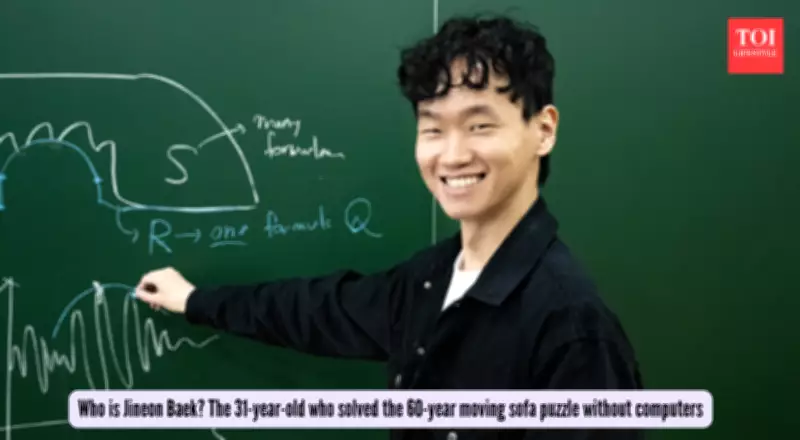
Jineon Baek: The Man Behind the Proof
Jineon Baek, a 31-year-old mathematics graduate from Pohang University of Science and Technology (POSTECH), has achieved global recognition for solving this long-standing geometry puzzle. His journey began unexpectedly during his mandatory military service at South Korea's National Institute for Mathematical Sciences, where he first encountered the moving sofa problem.
What intrigued Baek was not just the problem's difficulty, but the lack of a solid theoretical foundation to address it systematically. Instead of relying on computer experiments like his predecessors, he embarked on a seven-year quest to construct an airtight mathematical proof. This work spanned his PhD studies at the University of Michigan and continued at the June E. Huh Center for Mathematical Challenges at the Korea Institute for Advanced Study.
In late 2024, Baek uploaded his monumental 119-page paper to the arXiv preprint server. In this comprehensive document, he proves conclusively that Gerver's 1992 sofa shape is indeed optimal—no larger rigid form can possibly navigate the L-shaped hallway corner. Remarkably, Baek accomplished this without any computer assistance, using pure mathematical reasoning to reframe the problem as finding the absolute maximum possible shape.
The Significance of Gerver's Optimal Sofa
Gerver's sofa represents the ultimate solution to the moving sofa problem. With its area of approximately 2.2195 square units, this complex two-dimensional shape maximizes the use of available space while maintaining the rigidity required to slide and rotate around the corner. Baek's proof demonstrates that Gerver's design squeezes every possible bit of area from the hallway's constraints.
The shape's intricate geometry—combining straight lines and carefully calculated arcs—allows it to pivot through the tight turn without getting stuck. For decades, it stood as the largest known candidate, but only Baek's rigorous work has confirmed its maximal status. This resolution not only answers a specific geometric question but also advances broader mathematical understanding of optimization and spatial constraints.

Baek's achievement highlights the enduring power of human logic and theoretical mathematics in an age increasingly dominated by computational tools. By solving a puzzle that baffled experts for sixty years, he has cemented a place in mathematical history and inspired future generations to tackle seemingly intractable problems with creativity and perseverance.