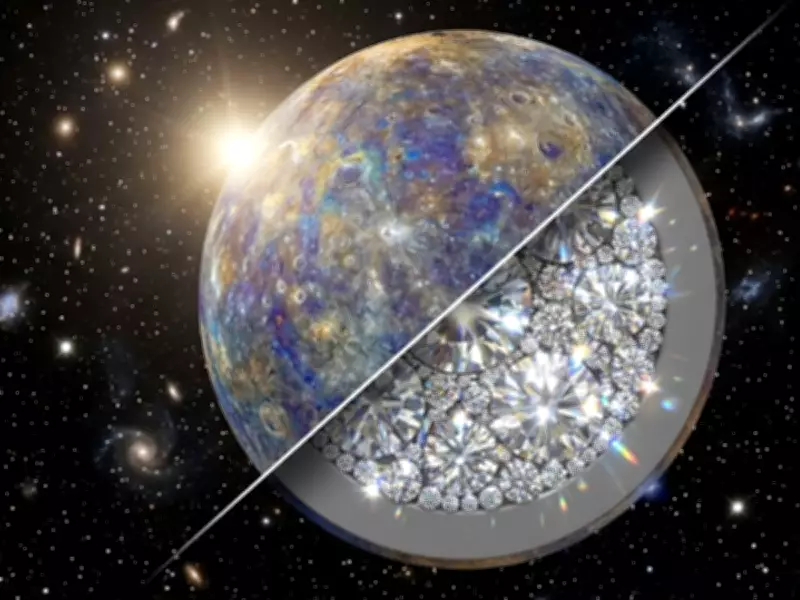
Imagine a place where the floor beneath your feet is not soil and rock, but a sparkling, mile-thick layer of diamond. This sounds like the setting of a big-budget sci-fi movie, but for Mercury, the smallest and fastest planet in our solar system, it could actually be the case. Long thought to be a hot, heavy iron ball, new research suggests that Mercury's interior is far more complex and high-end than previously imagined.
The Diamond Discovery
For a long time, Mercury was considered the odd one out. It is small, yet it harbors a massive metal core that constitutes the majority of its volume. It is baked by the sun, yet conceals ice in shadowed craters. Thanks to an amalgamation of lab pressure cookers and advanced space-based modeling, scientists now believe that a thick diamond layer exists between the planet's core and mantle.
How Does a Planet Form a Diamond Interior?
The process begins with a magma ocean. At the time of its formation, Mercury was likely a boiling, scorching chaos. As this vast lake of lava cooled, minerals began to crystallize. Since Mercury is extremely rich in carbon, scientists have long wondered where the carbon went. Initially, it was thought to be graphite, the same material found in pencils. However, Mercury's high-pressure environment naturally transforms graphite into diamond, which is more stable under stress.

Groundbreaking research led by Yongjiang Xu and published in the journal Nature Communications titled "The Diamond-Bearing Boundary Between the Mantle and Core on Mercury" has overturned the classic pencil lead concept. By mimicking the extreme temperature and pressure of Mercury's interior, researchers discovered that when sulfur is present during cooling, carbon turns into diamond, the most stable form of carbon.
Laboratory Simulations
Researchers used a multi-anvil press to subject synthetic minerals to pressures reaching seven gigapascals, about 70 times Earth's atmospheric pressure. Under these extreme conditions, carbon transformed into diamond. According to the study, as Mercury's core solidified, carbon was pushed outward, forming a diamond layer that could be up to 15 kilometers thick. This discovery may explain the planet's strong magnetic field and offers clues for identifying habitable exoplanets.
Why a Diamond Layer Matters for Us
One might ask what significance a diamond layer hundreds of miles away holds for people on Earth. This sparkling layer is crucial for understanding planetary magnetic fields. Mercury possesses an unusual magnetic field for such a small planet, which serves as a shield against solar radiation.
Diamond is an excellent conductor of heat. A thick layer along the mantle-core boundary could alter how heat flows from the planet's hot core to its surface. This thermal engine is responsible for keeping the magnetic field active. Understanding this helps scientists predict the habitability of other stars. If we can determine how Mercury preserved its magnetic shield, we might identify other planets in deep space that do the same.
Additionally, data from NASA's MESSENGER mission, which orbited Mercury for years, revealed bizarre dark spots on the surface. These patches are now known to be Low Reflectance Material with high carbon content. It appears that diamond is not just a static layer; it is part of a vast, ancient plumbing system that transported carbon from the interior to the surface.
The Future: BepiColombo
Although lab results are convincing, we will soon get a closer look. The BepiColombo mission, a joint venture of the European Space Agency and JAXA, is currently en route to Mercury and is expected to enter orbit in late 2025. The spacecraft is equipped with instruments capable of mapping the planet's gravity and internal structure with unprecedented precision.
If BepiColombo confirms the findings of the Nature Communications study, it could alter our understanding of how terrestrial planets develop. This implies that planets are not just huge rocks but living laboratories of chemical activity. The diamond layer theory not only makes Mercury more fascinating but also provides a blueprint for what to look for when searching for Earth-like moons around other stars.

Ultimately, Mercury shows us that the universe can be far more amazing than it appears from the outside. What was once considered a barren, broken rock for centuries is actually an incredible treasure trove of physics, chemistry, and perhaps trillions of carats of diamond.