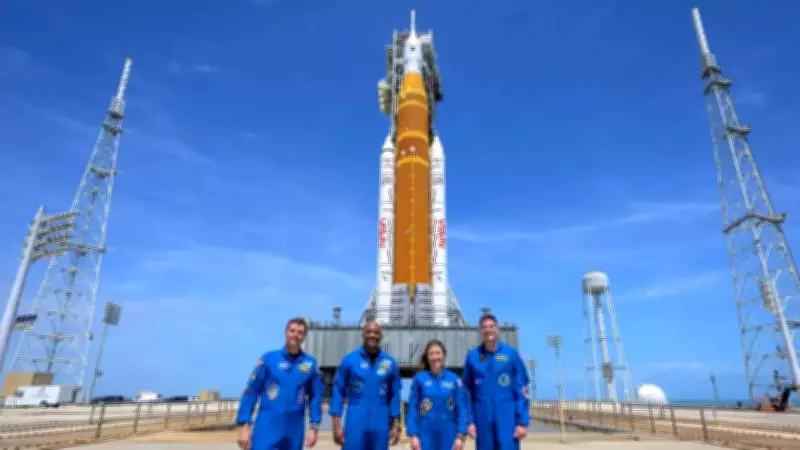
NASA Artemis II Moon Mission Launch: A Historic Return to Lunar Exploration
NASA has initiated the fueling process for its Space Launch System rocket, setting the stage for the Artemis II mission launch. This event marks a pivotal milestone in human space exploration, as it represents the first crewed journey to the Moon's vicinity in over five decades. The mission is scheduled for liftoff at 3:54 am IST on April 2 from Kennedy Space Center, with engineers conducting final checks and monitoring systems after earlier concerns about hydrogen leaks.
Crew Composition and Mission Profile
The Artemis II mission will carry four astronauts on a groundbreaking voyage. The crew includes Christina Koch, who will become the first woman to travel beyond low Earth orbit; Victor Glover, the first Black astronaut to embark on such a journey; and Jeremy Hansen, the first non-American to venture into deep space. Commander Reid Wiseman will lead the team, making him the oldest astronaut to reach the Moon's vicinity.
This mission is a crewed test flight focused on validating critical systems rather than landing on the lunar surface. The spacecraft will follow a free-return trajectory around the Moon, utilizing lunar gravity to loop back to Earth without requiring major engine burns. This safety approach, pioneered during the Apollo missions, ensures a controlled return path.

Technical Challenges and Objectives
Engineers are meticulously managing the cryogenic fueling process, which involves loading over 700,000 gallons of super-cooled liquid hydrogen and liquid oxygen into the 32-story rocket. Automated launch sequencing and nitrogen gas purging are part of the final preparations to ensure a stable environment.
Key mission objectives include:
- Testing the Space Launch System and Orion spacecraft in crewed conditions
- Validating life support and communication systems during deep space travel
- Assessing reentry capabilities at unprecedented speeds
At its farthest point, the spacecraft will travel approximately 4,700 miles beyond the Moon, setting a new record for the deepest human venture into space. Reentry will pose significant challenges, with Orion expected to hit Earth's atmosphere at around 25,000 miles per hour—the fastest crewed reentry ever attempted. NASA has cleared the heat shield after extensive reviews following the uncrewed Artemis I mission.
Historical Significance and Future Implications
Artemis II is not merely a technological achievement; it symbolizes a new era in space exploration. The mission serves as a critical stepping stone toward NASA's ambitious goals, including:
- Establishing a sustained human presence on the Moon
- Enabling crewed missions to Mars in the coming decades
- Paving the way for Artemis III, which aims to land astronauts near the lunar south pole by 2028
The success of Artemis II will directly influence the timeline and feasibility of these future endeavors. It represents a collaborative effort, with international support highlighted by messages from figures such as King Charles III of England to Canadian astronaut Jeremy Hansen.
Pre-Launch Preparations and Countdown
In the hours leading up to launch, the astronauts are undergoing final medical checks and quarantine protocols to ensure physical readiness. The pre-launch phase emphasizes stability and relaxation, allowing the crew to conserve energy and maintain alertness for the demanding journey ahead.
Launch director Charlie Blackwell-Thompson has reported that preparations have proceeded smoothly, with only minor ground equipment issues. The automated ground launch sequencer will control thousands of commands in the final minutes, ensuring precision timing for liftoff.
As humanity stands on the brink of this historic return to deep space, the Artemis II mission encapsulates both the spirit of exploration and the advancements in aerospace technology. From the complex fueling operations to the high-stakes reentry, every aspect of this mission is designed to test limits and expand the horizons of human capability. With favorable weather forecasts and global anticipation, the world watches as NASA prepares to reignite the journey to the Moon and beyond.