NASA Astronaut Shares Breathtaking 'Earthset' Video Filmed on iPhone During Lunar Mission
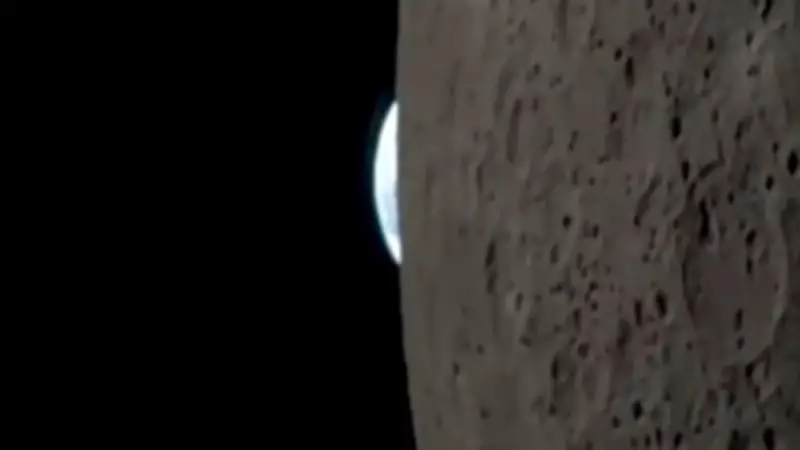
NASA astronaut Reid Wiseman has released a captivating 53-second video showing Earth gradually disappearing behind the Moon's cratered surface, a phenomenon he termed an "Earthset." The footage was captured during the historic Artemis II mission, which concluded its journey on April 11.
Personal Smartphone Makes Space History
In a social media post, Wiseman revealed the video was shot using an Apple iPhone 17 Pro Max at 8x zoom. "Only one chance in this lifetime," he wrote, comparing the experience to watching a sunset from "the most foreign seat in the cosmos." The astronaut explained he could barely see the Moon through the docking hatch window, but the iPhone proved perfectly sized to capture the extraordinary view.
"This is uncropped, uncut with 8x zoom which is quite comparable to the view of the human eye," Wiseman added, inviting viewers to enjoy the unique perspective.

NASA Approves Personal Devices for Documentation
The Artemis II mission marked a significant milestone as one of the first crewed spaceflights where NASA officially permitted astronauts to bring personal smartphones aboard. The crew carried four iPhone 17 Pro Max units, utilizing consumer technology to document their lunar journey.
The Earthset video powerfully demonstrates how small our planet appears when viewed from deep space. Over approximately eight seconds, a section of the blue-and-white Earth comes into view, creating a striking visual contrast against the dark void of space and the Moon's gray, pockmarked surface.
Gradual Disappearance of Our Home Planet
As the video progresses, Earth initially appears as a bright white sphere with its characteristic blue hues gradually fading. Over the next twenty seconds, the planet slowly moves completely out of sight behind the lunar landscape, completing what astronauts describe as an Earthset—the orbital equivalent of a terrestrial sunset.
Wiseman's narration reveals additional details about the documentation process. Fellow astronaut Christina Koch simultaneously captured high-resolution photographs using a Nikon camera with a 400mm lens, while astronauts Victor Glover and Jeremy Hansen observed from adjacent windows.
Smartphone Photography Revolutionizes Space Documentation
Earlier in April, NASA released a series of remarkable images taken with the iPhone 17 Pro Max during the Artemis II mission, representing the first official use of consumer smartphones to document a crewed lunar expedition. The photographs, captured on April 2, 2026, show astronauts Wiseman and Koch gazing back at Earth through the Orion spacecraft's windows.
NASA described one particularly poignant image showing "NASA astronaut and Artemis II mission specialist Christina Koch peering out of one of the Orion spacecraft's main cabin windows, looking back at Earth, as the crew travels towards the Moon."
The successful integration of everyday technology like smartphones into space missions demonstrates how accessible tools can provide unprecedented perspectives on human exploration beyond Earth's atmosphere.