

Nagpur and Chandrapur Set for Partial Lunar Eclipse on March 3, 2026
Skywatchers in Nagpur and Chandrapur are in for a celestial treat as a partial lunar eclipse will be visible at moonrise on March 3, 2026. This event marks the only eclipse that will be observable from India during the entire year, offering a unique astronomical spectacle for residents of the Vidarbha region.
Eclipse Details and Timing
According to Suresh Chopane, president of the Sky Watch Group, the partial phase of the lunar eclipse is scheduled to commence at 3:20 PM. This will be followed by the total phase starting at 4:34 PM, which will conclude at 5:32 PM. However, due to the Moon's position below the horizon for most of India during the total phase, a complete total eclipse will only be visible from Arunachal Pradesh.
In Nagpur and Chandrapur, approximately 25% of the Moon will appear covered, providing a brief yet notable view for local enthusiasts. The eclipse will be visible across Vidarbha roughly between 6:18 PM and 7:33 PM, offering a window of opportunity for observation.

Regional Visibility Variations
Visibility of the eclipse will vary significantly across different Indian cities:
- Kolkata: Around 90% of the eclipse will be seen.
- Gadchiroli: Approximately 30% visibility.
- Nagpur and Chandrapur: Nearly 25% coverage.
- Pune: About 10% visibility.
- Mumbai: Only about 1% of the eclipse will be observable.
This gradient in visibility highlights the localized nature of the event, with eastern regions experiencing a more pronounced view.
Global Reach and Viewing Tips
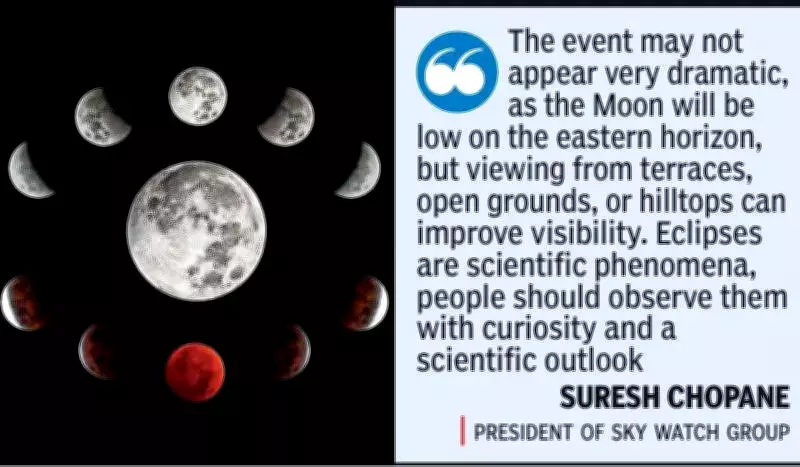
Globally, the partial lunar eclipse will be visible across several regions, including Pakistan, Afghanistan, India, and Australia, making it a widespread astronomical occurrence. Suresh Chopane notes that the event may not appear overly dramatic, as the Moon will be positioned low on the eastern horizon. To enhance visibility, he recommends viewing from elevated locations such as terraces, open grounds, or hilltops.
Chopane emphasizes that eclipses are scientific phenomena and should be observed with curiosity and a scientific outlook. This approach not only enriches the viewing experience but also fosters a deeper appreciation for celestial mechanics.
As 2026 approaches, residents of Nagpur and Chandrapur, along with other parts of India, can look forward to this rare celestial event, which promises to be a highlight for astronomy enthusiasts and casual observers alike.






