

ISRO's PSLV Failures Potentially Impacting Gaganyaan Human Spaceflight Programme
Hyderabad: The consecutive failures of missions involving the Indian Space Research Organisation's (ISRO) reliable Polar Satellite Launch Vehicle (PSLV) have raised concerns about whether they are slowing momentum on India's ambitious human spaceflight programme, Gaganyaan. Multiple suppliers of critical systems and subsystems for the spaceflight initiative suggest that this may indeed be the case.
Vendors Report Delays and Reduced Engagement
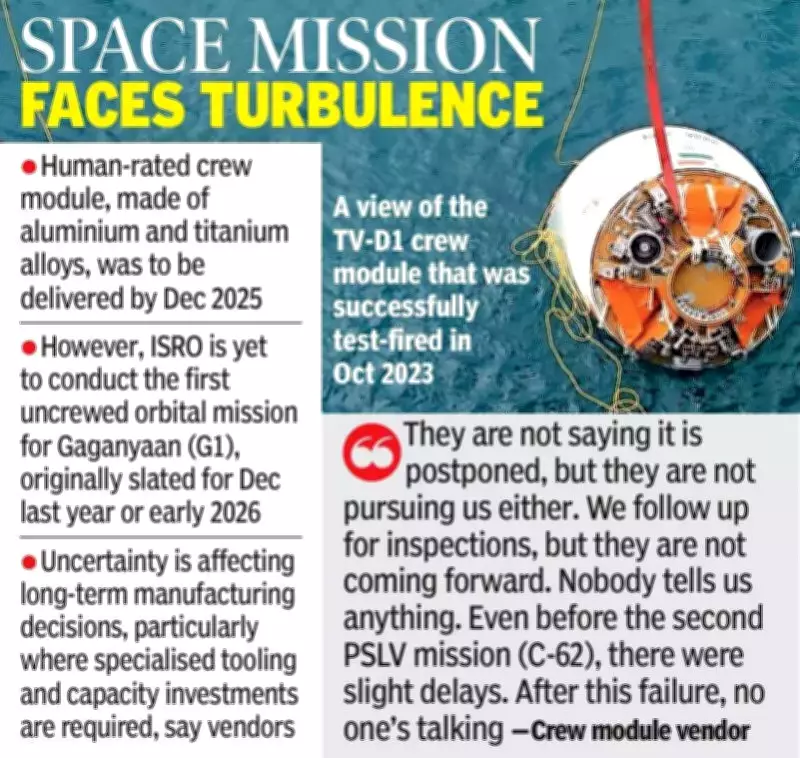
Several vendors have pointed to fewer technical reviews, delayed inspections, and limited clarity on delivery schedules as ISRO appears to shift its focus towards failure analysis. A vendor involved in crew-module hardware confirmed significant delays, stating that their completed human-rated crew module for the uncrewed mission still requires pressure testing, but ISRO is not showing interest and is merely postponing actions.
The human-rated crew module, constructed from aluminium and titanium alloys, was originally scheduled for delivery by December 2025. However, ISRO has yet to conduct the first uncrewed orbital mission for Gaganyaan (G1), which was initially planned for December last year or early 2026. The vendor added, "They are not saying it is postponed, but they are not pursuing us either. We are following up for inspections, but they are not coming forward. Nobody is telling us anything."

Cascading Effects on Suppliers and Manufacturing
A senior official at a company supplying crew module escape-related subsystems also acknowledged delays, noting that recent launch setbacks seem to have pushed ISRO teams into a closed-door assessment mode, reducing routine engagement with Gaganyaan vendors. "Honestly, after this failure, the whole ISRO team seems to be in failure-analysis mode. I don't really know what is happening. They are not even talking much about Gaganyaan now," the executive said.
This shift in focus has had a cascading effect on suppliers awaiting oversight and acceptance checks before hardware can proceed to the next stage of integration. Another company involved in crew-module hardware highlighted that the uncertainty is affecting long-term manufacturing decisions, particularly where specialised tooling and capacity investments are required. "These PSLV failures seem to have had a psychological impact. They are conducting many more tests. The focus now is on documentation rather than evaluating the actual product," the vendor explained.
Spacetech insiders note that any launch failure typically results in the industry entering an assessment phase. "Every failure is a lesson for the entire industry. Even today, launches are relatively few," said a spacetech startup founder. One company had prepared a new facility for evaluation, but a planned visit by ISRO officials did not materialise after the PSLV failures.
Some Suppliers Report No Broad Slowdown
However, not all suppliers report a widespread slowdown. The promoter of a company that delivered multiple subsystems for the crew module and crew escape system indicated that work continues, albeit with less public communication. "They are doing everything in the background. Perhaps they don't want to make it public because of the pressure, especially after the consecutive PSLV failures," he said.
An official at another company supplying avionics and other subsystems noted that some workstreams were continuing "as per schedule," with orders placed and timelines communicated to vendors. This suggests that while certain aspects of the Gaganyaan programme may be facing delays, other components are progressing without significant interruption.






