

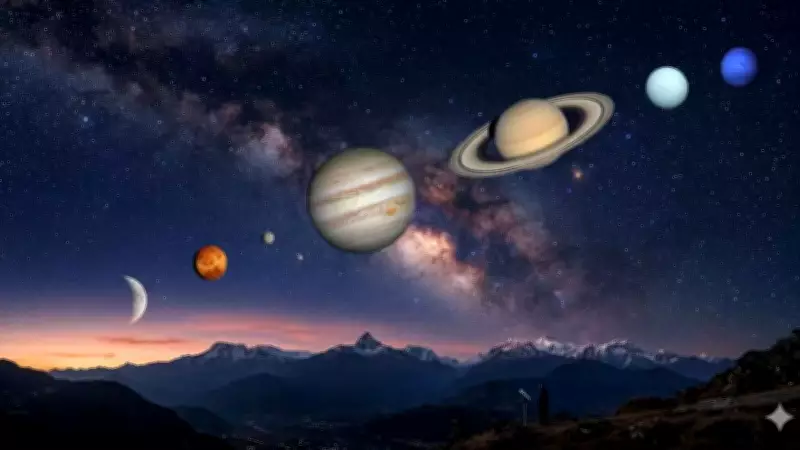
UK Skywatchers Await Rare Planetary Parade: Six Planets to Align This Weekend
This weekend, if weather conditions permit, skywatchers across the United Kingdom might witness a spectacular celestial event. A rare planetary parade is set to occur, with six planets gathering in the evening sky, offering a stunning visual treat for astronomy enthusiasts.
What Is a Planetary Parade?
A planetary parade refers to a phenomenon where multiple planets appear to line up in the sky from Earth's perspective. It is not a perfect straight line in space, as explained by Dr. Becky Smethurst, a Royal Astronomical Society research fellow. She notes that all planets orbit in the same flat plane around the Sun, similar to spinning pizza dough overhead, creating this alignment illusion.
Planets Visible in the Parade
The planetary parade will feature six planets:

- Mercury and Venus: These will be visible without any equipment, shining brightly at magnitudes -3.8 and 0.3, respectively. They will sit low near the western horizon.
- Saturn and Jupiter: Saturn, at magnitude 1, is visible to the naked eye, though it is moving toward the Sun's glare. Jupiter, glowing at magnitude -2.3, will be higher in the Gemini constellation and easy to spot even in areas with light pollution.
- Uranus and Neptune: Uranus, at magnitude 5.7, will require binoculars and can be found beneath the Pleiades cluster. Neptune, at magnitude 8, will need a small telescope for viewing.
Best Viewing Times and Locations
The closest grouping of planets is expected on 28 February, with Sunday being the optimal viewing day in the UK. Experts recommend finding a location with a clear horizon, away from city lights, to enhance visibility. The event will last for several days or weeks, so even if you miss the peak, planets like Mercury and Venus will remain visible into early March.
Tips for Skywatchers
To maximize your viewing experience:
- Let your eyes adjust to the dark for 5-10 minutes before observing.
- Use a picnic blanket or chair to avoid neck strain.
- Dress warmly for cold evenings.
- If using a phone app, switch to red light mode to preserve night vision.
Patience is key, as each planet offers a unique glimpse into our solar system.
Additional Celestial Features
Alongside the planets, observers might spot a 92%-illuminated waxing gibbous Moon rising in the eastern sky below Jupiter. With binoculars, the Beehive Cluster (M44), one of the brightest star clusters, can also be seen nearby.
This planetary parade is a rare but not impossible event, providing an excellent opportunity for both amateur and seasoned skywatchers to enjoy the wonders of the night sky.






