

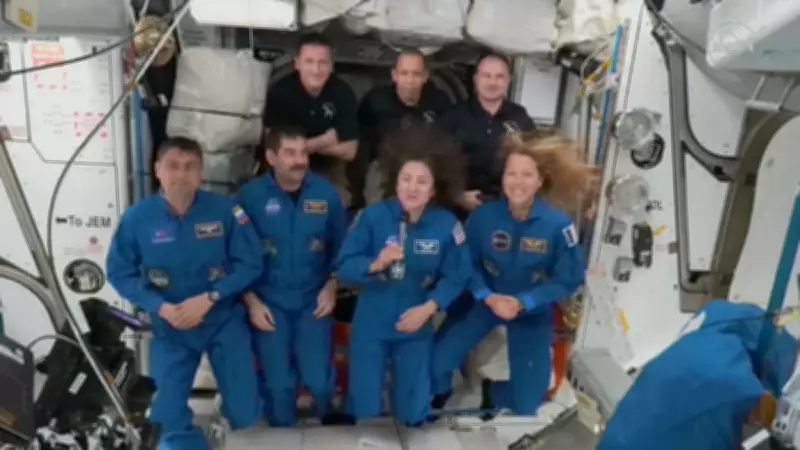
SpaceX Crew-8 Mission Successfully Docks with International Space Station
The International Space Station (ISS) has returned to its full operational crew strength following the successful arrival of the SpaceX Crew-8 mission. This marks a significant milestone in ongoing space operations, ensuring the orbiting laboratory is adequately staffed for its scientific and maintenance duties.
Restoration of Full Crew Complement
With the safe docking of the SpaceX Dragon spacecraft, the ISS now hosts a complete crew of seven astronauts. This restoration is crucial for maintaining the station's extensive research agenda and operational efficiency. The arrival of the four new crew members ensures that all critical systems and experiments can be managed without interruption.
Details of the Crew-8 Mission
The Crew-8 mission, launched by SpaceX under NASA's Commercial Crew Program, transported a diverse team of astronauts to the ISS. The crew includes experienced spacefarers and newer members, all selected for their expertise in various scientific disciplines. Their journey aboard the Dragon capsule proceeded smoothly, with the spacecraft performing a series of precise maneuvers to align with the station's docking port.

This mission underscores the reliability of SpaceX's crew transportation capabilities, which have become a cornerstone of NASA's strategy for maintaining a continuous human presence in low Earth orbit. The successful docking not only replenishes the crew but also delivers essential supplies and equipment to support ongoing missions.
Implications for ISS Operations
The return to full crew strength allows the ISS to operate at optimal capacity. With seven astronauts on board, the station can efficiently conduct a wide range of activities, including:
- Advanced scientific research in microgravity environments
- Routine maintenance and upgrades to station systems
- Preparation for future space exploration initiatives
This enhanced crew size is particularly important as the ISS enters a phase of increased experimentation and technology testing, which are vital for future missions to the Moon and Mars.
Background and Context
The ISS typically operates with a crew of seven astronauts, but temporary reductions can occur due to crew rotations or logistical challenges. The Crew-8 mission addresses such a gap, ensuring that the station remains fully functional. SpaceX's role in this mission highlights the growing partnership between government space agencies and private companies in advancing human spaceflight.
Looking ahead, the restored crew will focus on a packed schedule of research projects, including studies on human health in space, materials science, and Earth observation. Their work contributes to global scientific knowledge and paves the way for deeper space exploration.






