

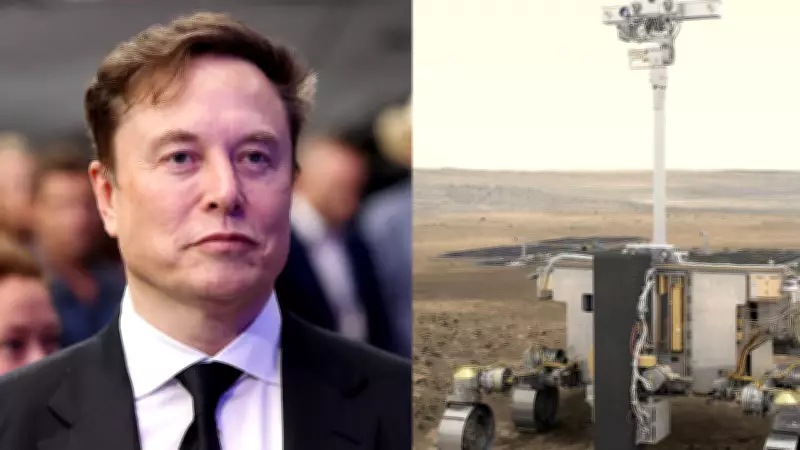
SpaceX Secures Historic Mars Rover Launch Contract for 2028
In a landmark development for interplanetary exploration, Elon Musk's SpaceX has been scheduled to launch the European Space Agency's Rosalind Franklin rover to Mars in 2028. This ambitious mission will utilize the formidable Falcon Heavy rocket, marking a significant milestone in the collaboration between governmental space agencies and commercial aerospace enterprises.
Rosalind Franklin Rover: Humanity's Deepest Search for Martian Life
The Rosalind Franklin rover represents one of the most sophisticated scientific instruments ever designed for extraterrestrial investigation. As the centerpiece of the European Space Agency's ExoMars program, this robotic explorer has a singular, profound objective: to detect biosignatures of past or present life on the Red Planet.
What makes this mission exceptionally unique is its unprecedented drilling capability. The rover is engineered to penetrate up to two meters beneath the Martian surface, reaching depths that are shielded from cosmic radiation and surface contamination. This is crucial because, as scientists have established, no organic materials likely remain on Mars' exposed surface due to harsh environmental conditions.

The rover will be equipped with advanced analytical instruments, including a Mars Organic Molecule Analyzer (MOMA), which can identify and characterize organic compounds. As detailed in scientific publications, this technology represents a significant leap forward in astrobiology—the study of life's potential existence beyond Earth.
Falcon Heavy: The Commercial Powerhouse Enabling Deep Space Exploration
SpaceX's involvement through its Falcon Heavy rocket underscores a transformative shift in space exploration paradigms. Traditionally dominated by government agencies, major interplanetary missions are increasingly leveraging commercial launch capabilities. The Falcon Heavy, currently among the most powerful operational rockets globally, provides the necessary thrust to deliver the rover safely on its trajectory to Mars.
This partnership between NASA (providing sponsorship and collaboration), the European Space Agency (leading mission development), and SpaceX (handling launch operations) exemplifies how combining national resources with corporate innovation can overcome complex challenges in space exploration.
A Mission Reborn: Overcoming Delays Through International Cooperation
The Rosalind Franklin mission has navigated a turbulent path to its current 2028 launch window. Originally conceived years earlier, the project faced multiple postponements and complete restructuring following geopolitical tensions that disrupted previous international partnerships. According to analyses from scientific organizations like the American Association for the Advancement of Science, the mission required near-total redesign to accommodate new collaborative frameworks.
The decision to resurrect this mission through tripartite cooperation signals a new, resilient era in space exploration, where technical challenges and global uncertainties are addressed through flexible, multinational alliances.
Why Oxia Planum Could Hold Answers to Ancient Mysteries
The rover's destination—Oxia Planum—was carefully selected for its exceptional scientific potential. This Martian region contains extensive deposits of ancient clay minerals that formed in the presence of liquid water billions of years ago. Scientists consider such aqueous environments optimal for preserving potential evidence of microbial life, making Oxia Planum a prime location to investigate Mars' habitable past.
Mars continues to fascinate researchers due to its striking geological similarities to early Earth. By analyzing samples from these ancient clay-rich areas, the Rosalind Franklin rover could provide groundbreaking insights into whether life ever emerged on our planetary neighbor.
The Broader Implications: Beyond Scientific Discovery
With approximately one year remaining until the scheduled launch, this mission transcends mere planetary exploration. It embodies humanity's enduring curiosity and relentless pursuit of knowledge about our place in the cosmos. The fundamental question driving this endeavor—whether life exists beyond Earth—represents one of science's most profound inquiries.

This mission demonstrates how advanced technology now enables detection of minute organic traces that could revolutionize our understanding of life's prevalence in the universe. The collaboration between public institutions and private enterprise establishes a blueprint for future ambitious space ventures, potentially accelerating humanity's expansion into the solar system.
As preparations intensify for the 2028 launch, the Rosalind Franklin mission stands as a testament to international cooperation, technological innovation, and the insatiable human drive to explore the unknown. Its findings could reshape not only our comprehension of Mars but potentially alter our perspective on life's cosmic context forever.





