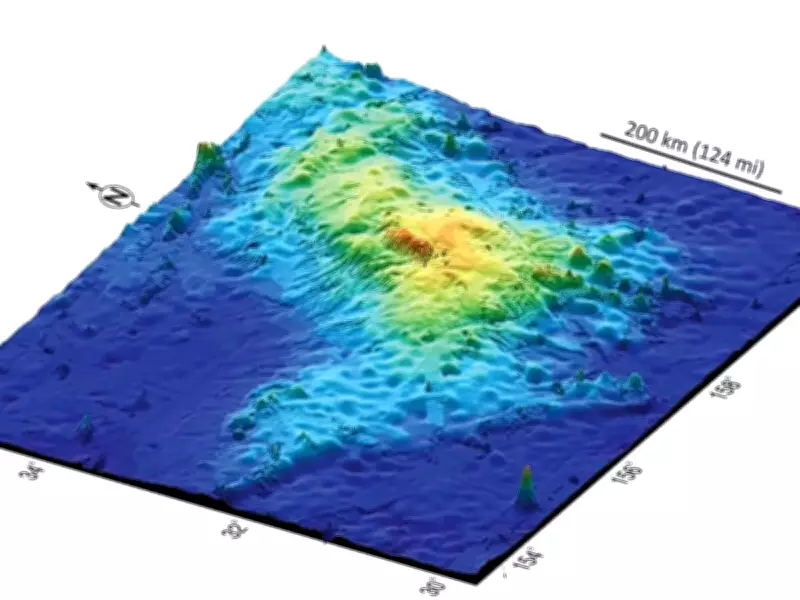
Among all volcanic systems known to humans, one of the most intriguing lies at the bottom of the Pacific Ocean. Known as the Tamu Massif, it gained attention when geologists proposed it might be the largest volcano on Earth. However, subsequent research has raised doubts about this initial hypothesis.
Location and Study Methods
The giant structure is located in the Shatsky Rise area of the northwestern Pacific Ocean. Like many underwater features, Tamu Massif cannot be observed directly. Geologists study it using seismic exploration, rock drilling, and bathymetric mapping.
Initial Discovery and Hypothesis
In 2013, a study published in Nature Geoscience suggested that Tamu Massif is a massive shield volcano. Based on multichannel seismic profiles and drilling data, scientists concluded that it formed as lava spread over vast areas of the seafloor, covering a region comparable in size to New Mexico. The presence of outward-dipping lava flows was cited as strong evidence for a shield volcano morphology.

Challenges of Underwater Exploration
Studying underwater volcanoes is far more challenging than studying terrestrial ones. The Pacific oceanic crust is covered by kilometers of seawater, making direct observation costly and difficult. Geophysical methods like seismic reflection imaging reveal rock stratification, while magnetic anomalies provide information about past cooling and motion. Drilling samples help piece together the geological history hidden beneath the seafloor.
Contradictory Magnetic Evidence
In 2019, another study in Nature Geoscience challenged the earlier interpretation. By analyzing magnetic anomalies in the oceanic crust, researchers found that the formation of magnetic stripes—created when lava solidifies and records Earth's magnetic field—suggested a connection to seafloor spreading rather than a single volcanic vent. This indicated that Tamu Massif may have been shaped by a combination of volcanism and tectonic activity, not just a centralized volcano.
Ongoing Significance
Despite the controversy, Tamu Massif remains one of the largest volcano-like structures on Earth. Its importance lies in helping scientists understand deep ocean bedrock and the complex processes that form huge volcanic edifices. Marine geologist William Sager from the University of Houston, involved in early studies, noted that Tamu Massif's unique shape sets it apart from other seamount chains.
This case illustrates how scientific knowledge evolves. Seismic evidence initially supported one hypothesis, while magnetic studies introduced another. Neither study was incorrect; together, they provide a more complete picture of how giant underwater mountains form.
A Dormant Giant
Although Tamu Massif resists easy classification, its resistance is why researchers remain fascinated. It may not be an ideal volcano, but it ranks among the largest volcanic constructs discovered. More importantly, it proves that the Pacific Ocean floor holds geological phenomena that can still surprise scientists.