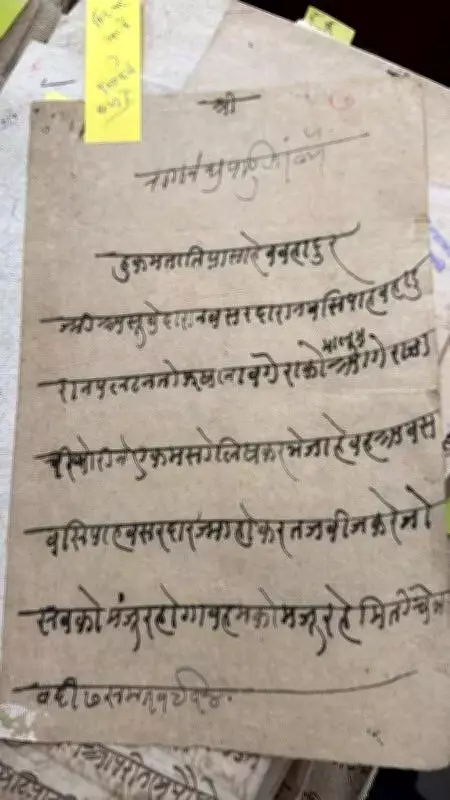
A brittle sheet of paper discovered from the stacks of Madhya Pradesh's archives has revealed the unmistakable signature of Tatya Tope, despite fading ink, and the pulse of a rebellion before it found its roar. Unearthed during the Centre's 'Gyan Bharat Mission' to digitise heritage records, the letter opens a rare window into the charged, clandestine months leading up to the 1857 war of Independence.
Dated 'Chaitra Badi 7, Samvat 1914' (1857 CE), the communication is addressed to subedars, sardars, sepoys and havaldars across princely states. Its sweep suggests a network already in motion, its tone hints at strategy rather than spontaneity.
Historical Significance
"This is not just a letter; it is a crucial historical link," said Madan Kumar Nagargoje, commissioner, directorate of archaeology, MP. "Tatya Tope's signature points out that this letter is rare and precious. It reflects minute planning and consultation before the revolt. This landmark discovery will lead to a better understanding of our history."

Journey of the Letter
The letter's journey mirrors its message. Archival records trace Tatya Tope's movement across central India — Baitul, Gadakota, Gwalior, Jhansi and Shivpuri — mapping a restless circuit of mobilisation, persuasion and preparation. The Directorate enlisted linguistic experts Syed Nayeemuddin and Amol Dnyaneshwar Mahalle to decode the text from Bundeli/Hindi rendered in Marathmoli script.
Content of the Letter
It references a proposal from the Raja of Charkhari, and calls for collective deliberation. "By order of Tatya Saheb Bahadur… all sepoys and sardars should assemble and deliberate. Whatever is agreed upon by all shall be acceptable to us," the letter reads.
The discovery is expected to shed new light on the coordination and planning that preceded the 1857 rebellion, challenging notions of a spontaneous uprising. Researchers are now studying the letter to understand the network of communication and alliances that Tatya Tope built across central India.