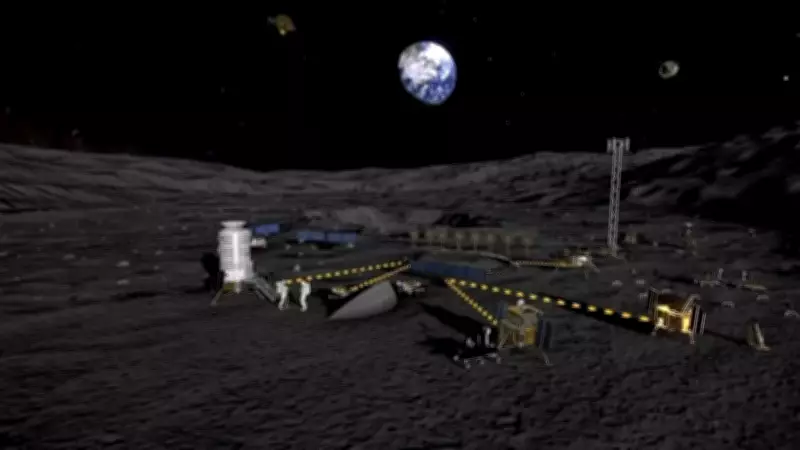
The New Frontier: Lunar South Pole Emerges as Prime Target in US-China Space Race
Humanity's enduring fascination with the Moon has entered a new competitive phase, with scientists from the United States and China racing to unlock its deepest secrets. The lunar south pole has become the focal point of this modern space race, recognized as a vital site for landing and conducting groundbreaking scientific research.
Why the South Pole is the Frontline of Lunar Exploration
The competition between the US and China extends far beyond symbolic flag-planting exercises. Both nations are pursuing the unknown secrets hidden within the Moon's geological formations. The South Pole offers exceptional conditions for observation and study, with one particularly intriguing location known as Rimae Bode.
A recent paper published in Nature Astronomy has described this area as a 'geological museum' due to its unique characteristics. Unlike the frozen or shadowed craters typically found at the poles, Rimae Bode contains volcanic plains, ancient highlands, and lava flow valleys resembling rivers—all concentrated in one remarkable location.

The 'Scientific Gold' of Volcanic Glass Beads
The exceptional scientific value of this region stems from the presence of pyroclastic deposits—tiny volcanic glass beads formed during volcanic eruptions over three billion years ago. These microscopic time capsules contain water and chemicals that originated deep within the Moon's mantle during ancient volcanic activity.
China's planned lunar lander mission for 2030 could potentially address numerous unanswered questions about the formation of both the Moon and Earth. This mission promises to deliver a significantly more detailed picture of lunar history compared to studies focused solely on polar lander formations.
China's Ambitious 2030 Moon Landing Strategy
China is pursuing a 'staged' approach to achieve a successful moon landing by 2030, departing from the all-in-one launch vehicle method used by NASA during the Apollo program. According to official mission profiles from the Chinese Manned Space Agency (CMSA), two separate Long March 10 rockets will launch the manned spacecraft Mengzhou (Dream Vessel) and the lander Lanyue (Embrace the Moon).
After successfully rendezvousing in lunar orbit, astronauts will transfer to the lunar lander for the final descent to the Moon's surface. This sophisticated approach demonstrates China's growing technological capabilities in space exploration.
The Tansuo Rover: China's Mobile Lunar Laboratory
China is currently developing the Tansuo crewed rover, designed to enable astronauts to explore the Moon's rugged terrain extensively. According to CMSA statements, this rover will accommodate two astronauts as they traverse the grey lunar soil.
The vehicle incorporates advanced banking technology to maintain stability while navigating slippery lunar regolith and steep inclines. Functioning as a mobile laboratory, the Tansuo rover will allow taikonauts to travel up to 10 kilometers from their lunar lander to collect 'scientific gold'—including volcanic glass beads and other mineral specimens that could revolutionize our understanding of Solar System history.
This comprehensive approach to lunar exploration—combining sophisticated landing strategies with advanced mobile research capabilities—positions China as a formidable competitor in the renewed race to understand and utilize Earth's closest celestial neighbor.