

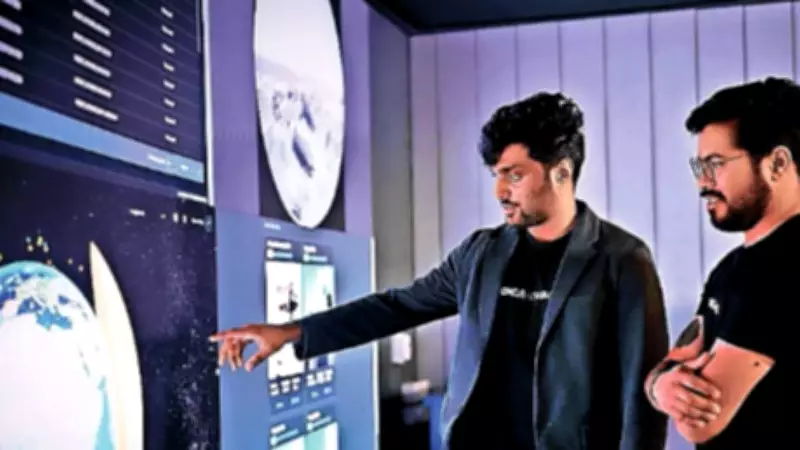
From College Dropout to Space Entrepreneur
In his third year at Lovely Professional University in Punjab, Anirudh Sharma made the bold decision to drop out of college and pursue his passion for space technology and defence. His father, a DRDO employee, had instilled in him a deep enthusiasm for defence. Between 2016 and 2018, Anirudh spent time mountaineering in Himachal Pradesh and Uttarakhand, where the clear night skies sparked his fascination with space.
Birth of Digantara
In 2020, Anirudh co-founded Digantara with two school friends, Rahul Rawat and Tanveer Ahmed. Their mission was to build technology for Space Situational Awareness (SSA), specifically to detect and track space debris. The startup soon secured a patent for an in-orbit LiDAR-based system designed to track debris. LiDAR, which stands for Light Detection and Ranging, uses laser light to measure distances and create 3D models of objects and environments.
This patent proved crucial when Anirudh sought to incubate the venture at the Indian Institute of Science (IISc) in 2020. "They told us this space needs PhDs, scientists – not people like us. The patent helped convince them that we were serious and capable," he recalls.

Growth and Expansion
Three years ago, with funding from Kalaari Capital, 360 One Asset, SBI Investment Japan, and others, Digantara moved into a 25,000-square-foot campus in Bengaluru. The company now employs around 150 people, 85% of whom are engineers working in fields like astrodynamics – the study of objects moving in space – to help satellites navigate without collisions.
Tracking Every Object
There are more than 17,000 active satellites in Low Earth Orbit (LEO), between 400 km and 2000 km above Earth. "Our job is to track every object that could be a satellite or space debris, build a catalogue of these objects, and predict their paths," Anirudh explains. "It’s like air traffic management, for space."
Digantara’s technology has three components: telescopes, satellites, and an analytics engine. The telescope network consists of six ground-based telescopes – three in India, two in Chile, and one in New Mexico. They also operate three satellites: two monitor space weather and radiation, while the third, Mission Scott, launched in 2025 on a SpaceX Falcon 9 rocket, provides space-to-space tracking.
The satellites carry sensors that track objects and relay data, including images, to the ground-based analytics centre. The data engine combines inputs from multiple sensors to determine an object’s position, velocity, and trajectory. The analytics software then translates this data into actionable intelligence. Each telescope observes hundreds of objects against the dense star field, with algorithms identifying moving objects, matching them against existing catalogues, and predicting their paths. Digantara has built everything in-house, from electro-optical payloads and LiDAR systems to analytics software.
Military Demand Explodes
Digantara’s primary offering targets the military, enabling them to track adversary satellites, monitor sensitive regions, and assess threats in real time. Anirudh sees space becoming the fourth domain of warfare – after land, sea, and air – and countries are investing heavily in monitoring orbital activity. Customers include Indian defence agencies and ISRO, the United States Space Command, the UK Space Agency, and defence bodies in Singapore and Thailand. Only a handful of companies globally offer end-to-end SSA capabilities.
Building the system has been challenging. Supply chains for advanced optical systems were weak in India, forcing the team to develop capabilities from scratch. Hiring was another hurdle; deep-tech talent was scarce, and many recruits came from academic or government backgrounds, requiring retraining for a commercial environment.

Yet, timing worked in their favour. The sharp fall in launch costs – driven largely by reusable rockets from companies like Elon Musk’s SpaceX – democratised access to space. As satellite launches surged, so did the need for traffic management and surveillance. "Many things that Musk and companies like Maxar Technologies have done led me into thinking how to develop a commercial space company," says Anirudh. For decades, governments were the drivers of space programs. From around 2015, commercial space ventures emerged, and reusable rockets changed the dynamics of how space was perceived. "As humanity increasingly explores life beyond Earth, someone has to build the navigation systems," he adds.





