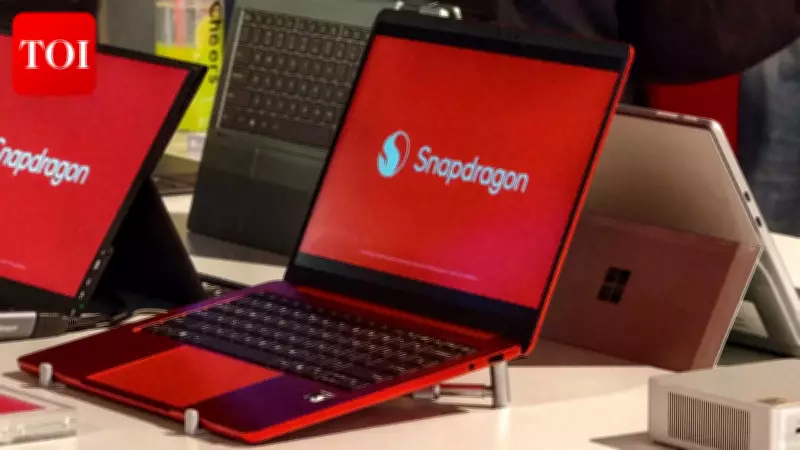
The cheap Windows laptop has been a subpar experience for fifteen years. Plastic shells, sluggish processors, batteries that die before lunch, and noisy fans have become the norm. The chip inside has changed names over the years, but the overall experience has stagnated. It is the only category in personal computing where the product has effectively gone sideways for a decade and a half, and buyers have learned to expect mediocrity.
That is the tier Qualcomm just entered with the Snapdragon C, unveiled ahead of Computex 2026. Designed for Windows laptops starting at $300, the first machines from Acer, HP, and Lenovo will ship later this year. The silicon uses Kryo cores from Qualcomm's smartphone lineup, rather than the Oryon cores found in Snapdragon X flagships. It includes an integrated NPU but does not meet Microsoft's Copilot+ bar. These are concessions in spec sheets, but not the ones that matter most to users.
Nitin Kumar, VP of Product Management for Snapdragon Chipsets at Qualcomm, spoke with TimesofIndia.com at Computex, explaining the company's strategy. His pitch focused less on the Snapdragon C product itself and more on why this chip exists at all. He believes the neglected part of the laptop market might be where Qualcomm has the best opportunity.

"Fundamentally, we're leveraging the technology on our mobile and PC portfolio," Kumar said. "A lot of the technology that drives the best experience on our mobile is leveraged onto our PC portfolio. That helps us differentiate from our x86 competitors, because they don't have a mobile platform." This line of thinking underscores the argument behind Snapdragon C: while Snapdragon X targets the premium segment, Snapdragon C goes for volume.
Snapdragon X has had a productive two years in its tier. The portfolio has grown from 22 designs at launch to over 150 today. Every major OEM now ships at least one Snapdragon laptop. Compatibility, once a major complaint, is no longer an issue. Qualcomm reports that Snapdragon chips account for 10% of the US Windows retail market for devices priced $800 and above. This is a significant foothold for a new architecture in a market that historically takes years to adopt new technology.
However, that figure does not include the rest of the market. At Computex 2024, Qualcomm CEO Cristiano Amon predicted that Snapdragon could make up 40 to 60% of some OEMs' laptop sales within three years. Arm CEO Rene Haas projected 50% of the Windows PC market in five years. These forecasts depend on the volume tier, where most laptops are actually sold. Until Snapdragon C, Qualcomm had not built a chip for that price point. India, where Snapdragon has strong brand recognition across all smartphone tiers, is a key market.
Kumar is patient about the timeline. Compatibility issues are resolved, OEM traction is strong, and the ecosystem is resonating well. The chip for the broader market is just now arriving. Snapdragon C is the first Qualcomm laptop chip designed specifically for this tier, and it does not have to compete with x86 on its home turf. It simply needs to be better than what consumers have been settling for.
Why $399 suits Qualcomm: Kumar's emphasis on mobile platform advantages is worth examining. While Intel and AMD have ventured into mobile, neither has spent the last decade primarily designing for a 4,000mAh battery and a fanless aluminum body. Qualcomm has. The Snapdragon X family was built on three pillars: real performance, all-day battery life, and on-device AI. These are the same goals Qualcomm has pursued for its phone chips for a decade. Buyers in the cheap laptop tier have never had all three together.
In a $399 laptop, the battery is small, the chassis is thin, cooling is minimal, and the bill of materials cannot absorb x86's inefficiency. Mobile design discipline is more critical here than in any higher tier. Apple's MacBook Neo has already demonstrated what a phone chip can do in a cheap laptop when the rest of the system is built around it. Snapdragon C is Qualcomm's Windows version of that idea.

The strategy mirrors Qualcomm's smartphone portfolio, which ranges from Snapdragon 8 down to 4 series, with consistent brand promise. The PC lineup now mirrors this: X2 Elite as the 8-series equivalent, X2 Plus and X as the 7 and 6 series, and Snapdragon C as the 4 series, bringing the brand to volume devices. "That is exactly what we're trying with our PC portfolio," Kumar said. India, where Snapdragon has built brand pull across all smartphone price points, is the ideal market for this translation. "The Indian consumer is very savvy. They like to get the best value for the price they're paying," he noted. "Our goal is to provide that same experience, deliver on that same promise, when an Indian consumer goes and buys a Snapdragon laptop."
The budget Windows laptop has been mediocre for fifteen years, not because chipmakers could not make a better one, but because the silicon used was never designed for that price point. It was scaled down to fit. Snapdragon C, built on cores designed from the start for those constraints, starts from a different foundation.
Qualcomm built the chip; now OEMs build the laptops. Kumar's view of the current market is sobering. The $300-to-$500 Windows segment already exists globally, including in India. People are buying these laptops, but they are not getting a product worth the money. "We believe the people buying these devices are getting a subpar experience," Kumar said. "They're not getting the right performance. In that price tier, the battery life is extremely compromised. AI capability is almost non-existent." Snapdragon C aims to change that.
Whether it succeeds depends on factors Qualcomm does not fully control. The $300 price point is guidance to OEMs, not a fixed price. A laptop's final cost depends on display, RAM, storage, camera, keyboard, and other configuration choices. Qualcomm provides the chip and a target range; Acer, HP, and Lenovo decide the rest. In a year when memory costs have doubled quarter-over-quarter, OEMs face pressure on every component. The buyer paying under $399 for a Snapdragon C laptop will experience whatever compromises the OEM made to hit that price. Good silicon in a poorly built laptop is still a poorly built laptop.
Kumar remains confident. "They are going to be really good devices," he said. "For that price point, it's gonna change the customer experience that somebody today is going and buys a $350, $399 device. They're in for a major uplift." The chip can deliver on the three pillars, but the rest of the laptop must also perform.
The Acer Aspire Go 15 ships first, a 15.6-inch plastic-bodied laptop with up to 8GB of RAM and 512GB of storage, two USB-C ports, and an HDMI socket. Acer has only stated it will be an "entry-tier price point" later this year. The 8GB RAM ceiling is a Snapdragon C limitation, set at the chip level. For all of Kumar's confidence, this ceiling raises questions. On-device AI was one of Snapdragon's launch pillars, but running AI alongside Windows, a browser, and several apps leaves little headroom with 8GB.
At Qualcomm's Computex demo, the Aspire Go's exterior looked adequate for a $399 promise, though a show floor reveals only appearance, not performance. HP and Lenovo's machines will follow, each representing a different OEM's approach to a $399 chip.
By the end of the year, we will know whether Qualcomm has succeeded in the budget tier as it has not yet at the top, and whether OEMs gave the Snapdragon C chip the device it deserves.