

10 Surprising Facts About Our Solar System That Will Amaze You
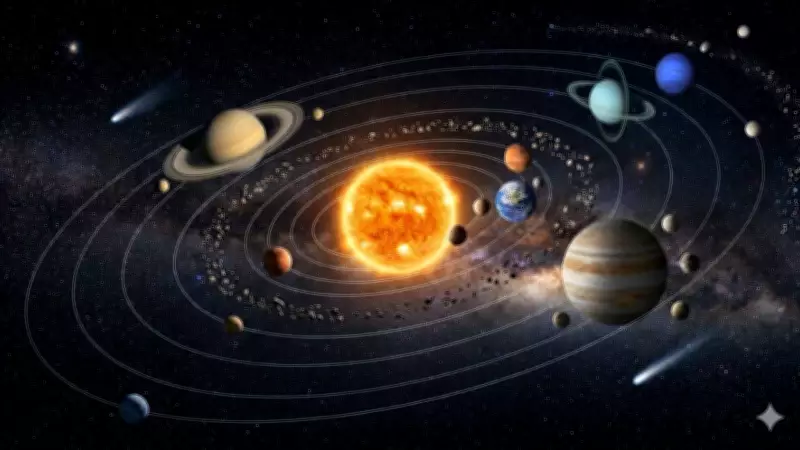
The Solar System is a realm of astonishing physics and geological marvels that often defy human comprehension. While classroom lessons simplify planetary order, reality unveils a far more complex and dynamic universe. For instance, Venus, despite being farther from the Sun than Mercury, boasts scorching temperatures and a volcanic surface, while ice giants experience 'diamond rain' in their atmospheres. According to NASA's Solar System exploration archives, the Sun alone contains 99.8% of the Solar System's mass. These 10 lesser-known facts highlight a cosmos brimming with surprises beyond any textbook narrative.
Mercury’s Massive Iron Core
NASA's MESSENGER Mission revealed that Mercury's metallic core constitutes about 85% of its radius, compared to Earth's core, which makes up only 50%. Scientists theorize that during the solar system's formation, a colossal collision may have stripped away Mercury's outer rocky layers, leaving behind this iron-rich heart.
The Mysterious Oort Cloud
Beyond Pluto lies the theoretical Oort Cloud, a vast 'bubble' of icy debris marking the outer limit of the Sun's gravitational pull. Located up to 1.6 light-years away, this distant region serves as the birthplace for most long-period comets that occasionally grace our skies.

The Sun’s Overwhelming Mass Dominance
NASA's Solar System Exploration data confirms that the Sun holds a staggering 99.86% of the solar system's total mass. In simpler terms, all planets, moons, asteroids, and comets combined account for less than 0.2% of the remaining mass. To visualize this scale, if the entire solar system were the size of a standard front door, Earth would be merely the size of a nickel coin.
Saturn: The Planet That Could Float
Saturn, a gas giant composed mainly of hydrogen and helium, has such a low density that it could float in water. NASA Science notes it is the only body in our solar system with a density lower than water, meaning if placed in a sufficiently large bathtub, Saturn would bob on the surface.
Why Venus Is the Hottest Planet
Despite Mercury's proximity to the Sun, Venus claims the title of the hottest planet. The European Space Agency attributes this to a 'runaway greenhouse effect,' where its carbon dioxide-rich atmosphere traps heat with extreme efficiency. This results in surface temperatures consistently reaching 470 degrees Celsius (878 degrees Fahrenheit), hot enough to melt lead.
Vast Distances Between Planets
Space is predominantly empty, as highlighted by the Jet Propulsion Laboratory. If all solar system planets were aligned end to end, there would still be approximately 8,000 kilometers of space between Earth and the Moon, underscoring the immense gaps that separate celestial bodies in the cosmic vacuum.
Diamond Rain on Ice Giants
Neptune and Uranus host dazzling weather phenomena deep within their atmospheres. Research from the SLAC National Accelerator Laboratory suggests that extreme pressures pull carbon from methane, forming diamonds that then 'rain' downward toward the planetary cores, creating a spectacular light show.
Jupiter’s Shrinking Great Red Spot
Jupiter's iconic Great Red Spot, a centuries-old storm, is gradually diminishing. In the 1800s, it spanned about 40,000 kilometers across—large enough to fit three Earths. Current data from space orbiters shows it has shrunk to 16,500 kilometers in diameter and continues to decrease annually.
Olympus Mons vs. Mount Everest
Mars boasts the solar system's most impressive geological feature: the Olympus Mons volcano. According to NASA's Mars Exploration Program, it stands 21.9 kilometers (13.6 miles) high, nearly three times taller than Mount Everest. Mars's lack of plate tectonic activity allowed this volcano to build up over billions of years at a single 'hotspot,' resulting in its colossal size.
The Kuiper Belt: A Cosmic Junkyard
Extending beyond Neptune, the Kuiper Belt is a vast collection of icy objects, often called a 'junkyard.' NASA's New Horizons Mission reports it contains millions of ice-cube-like shapes, with at least three recognized as dwarf planets: Pluto, Haumea, and Makemake. This belt also serves as a 'fossil record,' preserving clues about the early solar system's development.

