

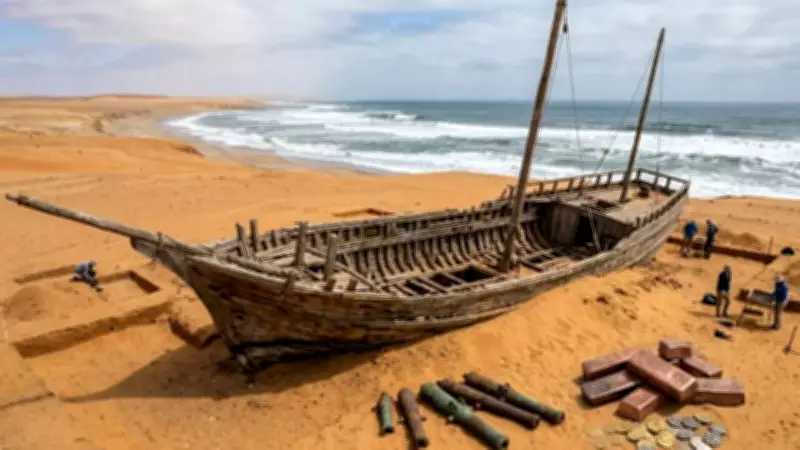
In 2008, a diamond mining operation near Oranjemund, Namibia, led to the discovery of a significant piece of history: the wreck of the Bom Jesus, a Portuguese merchant ship lost at sea in 1533. The vessel had been buried for over 500 years beneath layers of sand and water.
A Time Capsule from the Age of Discovery
The discovery allows archaeologists to view the wreckage as a time capsule from the Age of Discovery. The ship's contents were preserved almost perfectly, thanks to its cargo of copper ingots, which protected the ship from marine deterioration. The Bom Jesus opens up new opportunities to study global trade routes of the 16th century, shipbuilding techniques, and the hazards faced by early explorers in the treacherous Atlantic Ocean.
Gold, Ivory, and Cannons in Desert Sands
According to a report in The Mariner's Mirror, on March 7, 1533, the Bom Jesus left Lisbon for the Indian subcontinent carrying trade goods. Historical analysis indicates the ship foundered during a severe storm, driven toward the coast of Namibia and striking a rock shelf. Most human remains have not been located, suggesting some crew members survived the initial sinking, but the ship and its valuable cargo were buried beneath the sand of the Skeleton Coast for approximately 500 years.

How a Toxic Cargo Preserved History
During excavation, experts found more than 40 tons of cargo, including thousands of gold and silver coins, bronze cannons, navigational astrolabes, and several hundred elephant tusks. The artifacts escaped scavenging largely because they were located in an area protected from diamond mining. The items were well-preserved, including organic materials, due to the biocidal properties of the copper cargo, which prevented marine creatures from consuming the organic remains.
What Ivory and Copper Reveal About Early Global Trade
Considered one of the most important marine archaeological discoveries in southern Africa, the copper ingots (approximately 17 tonnes) bear the trident of the Fugger family of Augsburg, Germany, evidence that Renaissance Europe traded extensively with sub-Saharan Africa. The elephant ivory has yielded significant information on historical populations of West African forest elephants and how early global trade affected the environment.






