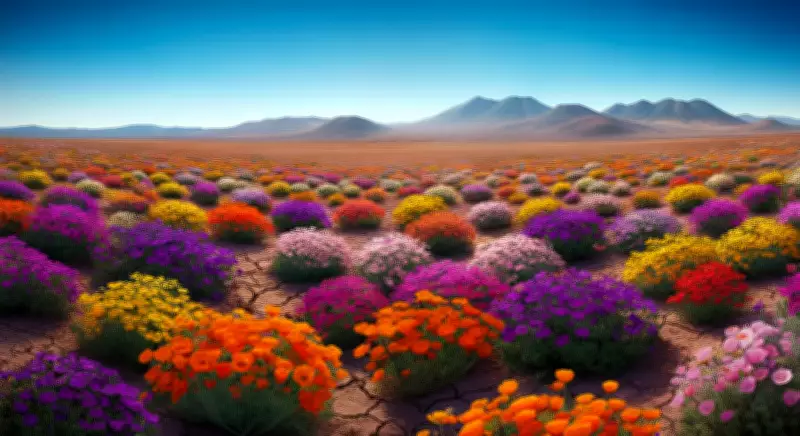
The Atacama Desert in northern Chile holds the record for being the driest non-polar desert on Earth. Some parts of it go decades without a single drop of rain. It looks, for most of the year, like a place where nothing could survive. And then, every few years, something extraordinary happens. The rains come, and within weeks, the cracked, dusty ground transforms into a carpet of colour stretching for kilometres in every direction. Yellows, purples, pinks, and whites cover the hills and valleys where nothing grew before. Locals call it the desierto florido, the flowering desert, and scientists call it one of the most dramatic ecological events on the planet.
What is the Atacama super bloom, and where does it happen
The Atacama Desert runs for roughly 1,600 kilometres along the Pacific coast of South America, sitting between the Andes mountains to the east and the Chilean Coast Range to the west. This geography is what makes it so dry. Both mountain ranges block moisture from reaching the desert floor, and the cold Humboldt Current running along the coast suppresses rainfall further. The result is a landscape that receives less than one millimetre of rain per year in its driest zones. The super bloom happens when that pattern briefly breaks. An El Niño weather event pushes warmer Pacific waters toward the South American coast, disrupting the normal atmospheric patterns and sending rainfall into regions that almost never receive it. When the rains are heavy enough and fall at the right time of year, dormant seeds that have been waiting in the soil for years, sometimes for more than a decade, suddenly germinate all at once.
Which flowers bloom in the Atacama Desert super bloom
The flowers that appear are not random. The Atacama supports around 200 plant species that have adapted specifically to survive long periods of drought as seeds, bulbs, or underground roots. When rain arrives, they respond fast. Among the most visible are pata de guanaco, a bright purple flower, añañuca, a vivid red lily, and suspiro de campo, a small yellow bloom that covers the ground in dense patches. Research tracking blooming desert events across the Atacama found that significant blooms have been recorded in years with a very strong El Niño effect, with rainfall thresholds of at least 15mm needed to trigger germination across most species. A light sprinkle produces a modest flowering. A sustained period of rain across several weeks, of the kind that comes with a strong El Niño, produces the full super bloom that draws visitors from around the world.

How seeds survive for years in one of the harshest environments on Earth
The more you look at how this works, the stranger it gets. Seeds lying in the Atacama soil are not simply waiting passively. Many have developed chemical coatings that prevent germination until a very specific threshold of moisture has been reached, a biological safeguard against germinating during a brief shower that won't last long enough to support a full growth cycle. Studies on seed dormancy in arid environments have shown that some Atacama species have seeds that remain viable for well over a decade in the soil. The desert is, in effect, a seed bank waiting for the right moment. When that moment arrives, the germination happens simultaneously across large areas, which is why the bloom appears so suddenly and covers such wide stretches of ground at once.
When was the last Atacama super bloom, and how often does it happen
The super bloom does not follow a fixed schedule. It is tied to El Niño events, which themselves vary in strength and frequency. Significant blooms were recorded in 1997, 2015, and again in 2017, with the 2015 event being one of the most widely photographed in recent memory. That year, the bloom was described by Chilean authorities as the most intense in at least 18 years, with flowers appearing across more than 75 kilometres of desert between Copiapó and Vallenar. Smaller, partial blooms occur more frequently, often in localised areas where rainfall happens to be sufficient. But the full super bloom, the kind that covers the hills completely and draws international attention, happens roughly once every five to ten years, depending entirely on whether a strong enough El Niño event delivers the necessary rainfall.

What climate change could mean for the Atacama super bloom
This is where the story becomes more complicated. El Niño events are expected to become more intense as global temperatures rise, which might suggest the super bloom could become more frequent. But research on climate change and Atacama precipitation patterns points to a more uncertain picture. Increased intensity of individual El Niño events does not necessarily mean more rainfall reaches the Atacama, and changing atmospheric patterns could alter where and how that rain falls. There is also the question of what happens to the seed bank over time if blooms become irregular or if temperatures during non-bloom years become hot enough to reduce seed viability. Scientists are still working through these questions, and the Atacama super bloom, for all its spectacle, is quietly becoming one of the more closely watched indicators of how desert ecosystems respond to a changing climate. For now, the seeds are in the ground, and they are waiting. They have been doing it for millions of years. The next rain heavy enough to wake them is, somewhere in the Pacific, already forming.