

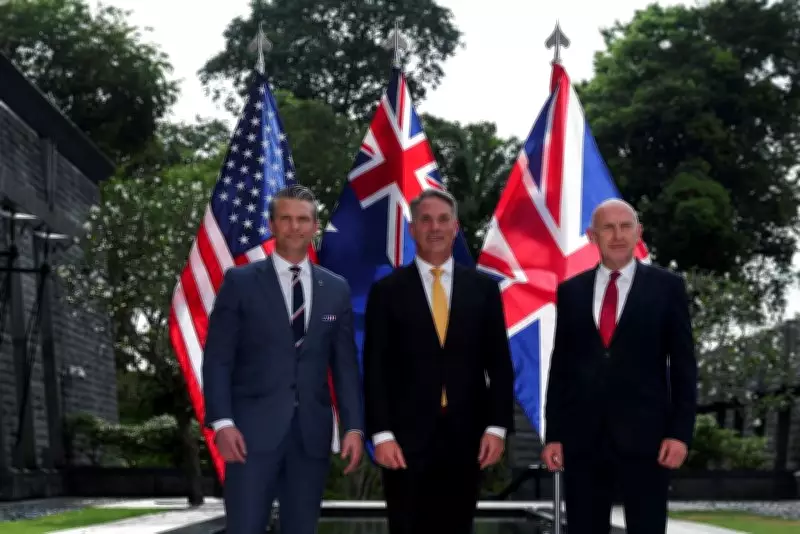
The trilateral security partnership between the United States, the United Kingdom, and Australia, known as AUKUS, has transitioned from a theoretical deterrent to an operational framework. On May 30, the partnership announced a two-pronged expansion: an undersea drone network to be operational by 2027 and the establishment of a nuclear-submarine rotational force in Australia by the same year. This development could significantly benefit India, which maintains independent ties with all three AUKUS partners in underwater domain awareness.
Undersea Drone Network: Pillar II of AUKUS
On May 30, AUKUS agreed to a signature project under Pillar II to develop cutting-edge weapons systems and sensors for underwater drones. This initiative involves creating payloads and enabling systems for Uncrewed Undersea Vehicles (UUVs), with initial deliveries beginning in 2027. The project aims to enhance the partners' ability to protect critical national seabed infrastructure, such as internet cables and oil and gas pipelines, as well as to deploy advanced surveillance, reconnaissance, and strike capabilities. Additionally, it will support logistics operations and bolster superiority in anti-submarine warfare, anti-surface warfare, and electronic warfare.
US Defence Secretary Pete Hegseth stated at the event, "The US won't let China impose hegemony in Asia."

Nuclear Submarine Rotational Force: Pillar I
AUKUS is also advancing its Pillar I initiative, which focuses on conventionally armed, nuclear-powered submarines (SSNs). Australia will acquire three in-service Virginia-class submarines rather than waiting for new ones to be built. The three countries confirmed that milestones for the Submarine Rotational Force-West (SRF-West) at Perth are being met. SRF-West will directly support submarine deployments in the region and accelerate Australia's readiness to own, operate, maintain, and regulate SSNs. The US and UK also operate nuclear-powered submarines with nuclear weapons (SSBNs).
Last month, the US authorized the establishment of US Navy support elements for SRF-West, with the first US Navy personnel rotating to HMAS Stirling at Perth later this year. A new submarine construction yard is being built in South Australia, and the design and delivery of specialized SSNs for AUKUS are underway. An entirely new nuclear-powered submarine model, based on a British design but incorporating technology from all three countries, will be built for the UK and Australian navies.
Australian Deputy Prime Minister and Defence Minister Richard Marles, who visited New Delhi for a defence dialogue with his Indian counterpart Rajnath Singh, commented on the submarine plan: "A nuclear-powered submarine is firstly to give pause for thought for any adversary that might seek to coerce Australia."
India's Links with AUKUS Partners
India has independent ties with all three AUKUS partners in underwater awareness. Last year, Liquid Robotics, a Boeing company, partnered with Sagar Defence and Engineering to co-develop and co-produce advanced maritime systems, including Uncrewed Surface Vehicles (USVs). Sagar inaugurated its plant in Pune last year. Liquid Robotics stated that the USVs manufactured at this facility will enhance undersea domain awareness.
In January last year, India and the US launched the Autonomous Systems Industry Alliance (ASIA), a bilateral initiative to foster collaboration between defence industries to co-develop and co-produce advanced autonomous systems, including AI-driven maritime drones.
India and the UK have launched Vision 2035, which includes a 10-year Defence Industrial Roadmap focused on time-bound co-design, co-development, and co-production of advanced technologies such as jet engines, naval propulsion, underwater systems, and directed-energy weapons.
An India-Australia joint statement on June 2 noted that Rajnath Singh and Marles discussed finalizing the Joint Maritime Security Collaboration Roadmap. They agreed to progress collaborative maritime domain awareness activities through maritime patrol aircraft and explore opportunities to enhance undersea domain awareness.

Last month, the Quad Foreign Ministers meeting in Delhi operationalized the Indian Ocean Region programme of the Quad Indo-Pacific Partnership for Maritime Domain Awareness (IPMDA) through the Information Fusion Centre – Indian Ocean Region in Gurugram. India, the US, Australia, and Japan are partners in the Quad.
Expert Analysis
Dinaker Peri, Fellow in Security Studies at Carnegie India, described the undersea drone network as a logical step. "The US and Japan already have a network of ocean bed sensors, and a drone network makes it more potent. Of course, it is intended to keep an eye on China's ever-expanding maritime domination." Regarding the nuclear submarine rotational force, he added that it means a much higher number of SSNs lurking in the waters of the Indo-Pacific. "China would surely up its game tailing and tracking them. It already has over 60 submarines. This does present an opportunity for India to join the network in some way, as Quad itself focuses on underwater domain awareness," Peri noted.





