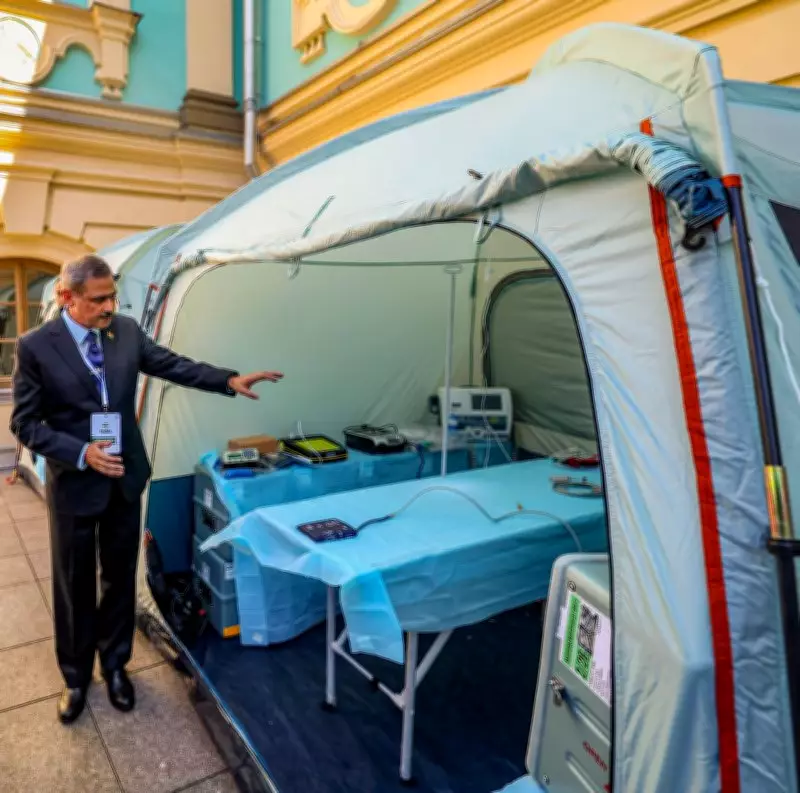
India's indigenous BHISHM (Bharat Health Initiative for Sahyog Hita and Maitri) cube portable field hospital was deployed in Venezuela following two major earthquakes, with a medical team setting it up in just 12 minutes to treat an influx of patients. The South American nation received immediate assistance from India, which airlifted the cubes to ensure rapid, on-the-ground trauma care in the disaster zone.
What is the BHISHM Cube?
The BHISHM cube comprises 72 easily transportable components designed to provide emergency care in disaster-stricken areas where setting up medical facilities is often unfeasible. According to its inventors, these portable field hospitals “bridge the crucial gap between primary and definitive care during the critical ‘golden hour’ (the critical first 60 minutes after a traumatic injury) of emergencies.”
Origin and Design
The innovation began in the winter of 2022 when a four-member task force led by Air Vice Marshal Tanmoy Roy met to engineer medical solutions for front lines, focusing on disaster management. Roy had firsthand experience with the difficulty of transporting bulky hospital loads to conflict and disaster zones. He developed a ‘Rubik’s Cube’ model, where each smaller cube (15x15x15 inches) carries essentials like medicines and surgical equipment. The completed BHISHM cube consists of 72 smaller cubes divided into two 36-cube structures, wrapped in a water- and corrosion-proof, military-grade cage with a tamper-proof shelf. The cage can be dismantled in various combinations using hinges and locks, depending on space requirements, fulfilling the project’s “last-mile connectivity” ambition.

Rapid Deployment in Venezuela
Once in the field, the BHISHM cubes take about 12 minutes to set up. The mini cubes are released from the frame row-wise, starting with those containing the generator and colour-coded inflatable tents. The cubes are colour-coded by medical priority: red trauma boxes go in the red triage tent, blue oxygen supply boxes in the blue tent, and so on. Devices like ventilators and patient monitors are pre-wired, so responders only need to hit power switches to make them ready.
Technological Integration
The system incorporates radio-frequency identification (RFID) for inventory management, allowing users to track stock, expiry dates, and usage via a tablet included in one of the cubes. Additionally, AI software helps sort patient data and make triage decisions, such as which case requires ventilator access or surgery first. It also enables tele-communication with experts for complex cases.
Official Acknowledgment
Venezuela’s Minister of Foreign Affairs Yvan Gil expressed gratitude after visiting a BHISHM cube hospital, stating, “We wish to express our most sincere gratitude to all the health professionals from the sister Republic of India, who provided care to the Venezuelan men and women affected by the earthquakes at the field hospital set up in La Rinconada, as part of Operation Amistad.”
Global Footprint
India previously shared BHISHM cubes with Ukraine in 2024 and Jamaica after Hurricane Melissa last year, expanding the innovation's global footprint in disaster response.