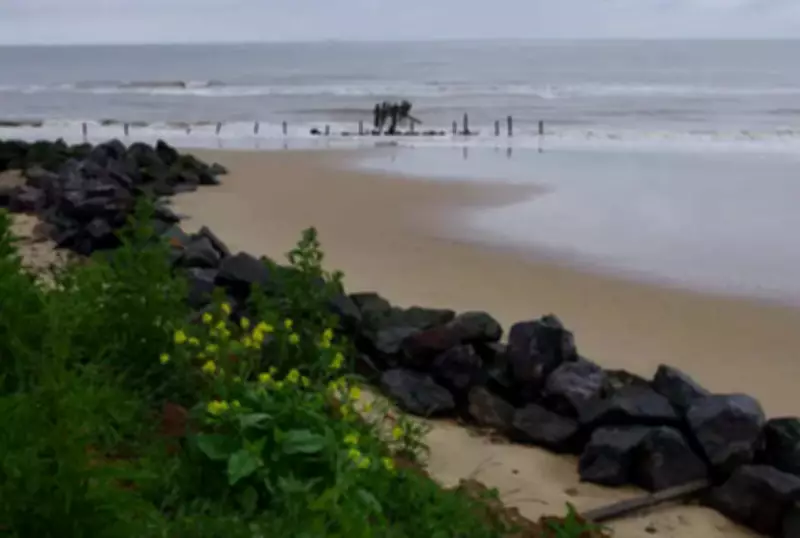
Walking by a windswept coast with a companion animal is often considered the epitome of relaxation on a tranquil Saturday morning. For a regular beach-goer investigating the coast of East Anglia, however, a simple walk upended previous knowledge regarding the period when early hominins settled in northern Europe. On a spring day in 2000, a dog walker traversing the wet, tidal beaches of Happisburgh in Norfolk spotted something unusual.
The object was smooth, dark, and heavy, standing out from the thousands of ordinary pebbles scattered across the shore. Recognizing that the rock possessed distinct, intentionally chipped edges, the walker picked it up and passed it to local museum specialists for evaluation.
It soon became evident that what initially seemed like just another stone broken by the waves was actually an exquisite teardrop-shaped hand axe. The rare artifact had been exposed by the powerful tides of the North Sea, slicing through ancient, deep layers of the coastal cliffs.

Shattering the Limits of Early Human Habitation
The find excited the archaeological community instantly, as the site indicated that humans inhabited areas where they were not believed to exist in early history. In the scientific journal Nature, the groundbreaking paper titled "Early Pleistocene human occupation at the edge of the boreal zone in northwest Europe" indicated that the human geological layer existed over 780,000 years ago. Before this critical artifact came to light, conventional historical timelines asserted that early humans lacked the survival skills, clothing, and tools necessary to endure the harsh, chilly environments of northern Europe so early in history.
There was no ambiguity regarding the genuine human origins of the flint tools. According to the Natural History Museum's research program named "Pioneering Populations," the object is a very advanced Lower Palaeolithic handaxe that represents one of the oldest artifacts fashioned using black flint by our ancient ancestors. They actively chipped and shaped it into a sharp double-bladed tool. Such a tool became extremely useful for cutting trees and bushes to hunt animals in a prehistoric floodplain. This discovery shattered previous assumptions about hominin survival in harsh climates, revealing a sophisticated toolmaker.
How a Shifting Coast Reveals Our Most Distant Origins
The scientific value of the Norfolk handaxe dramatically increased when scientists realized that this beach was not just a place where an individual dropped a tool but actually served as a doorway to an enormous prehistoric ecosystem where remnants of worked stone flakes, cut animal bones, and plants were found.
Today, this fragile stretch of the British coast serves as an active, unpredictable archive of ancient history. The natural forces of coastal erosion and heavy winter storms act as a double-edged sword; they can quickly wash away priceless historical context, but they also pull magnificent secrets out of the dark clay into the modern light.
This example shows that great scientific discoveries are not always made through highly financed missions. It may be enough to have good eyes, an inquisitive mind, and to take a stroll on a beach that happens to be public.
It is certainly an incredible thought, knowing that while all those generations of humans built sandcastles and relaxed on the beaches of Norfolk, the perfectly preserved product of another era lay underwater only a few feet away.