

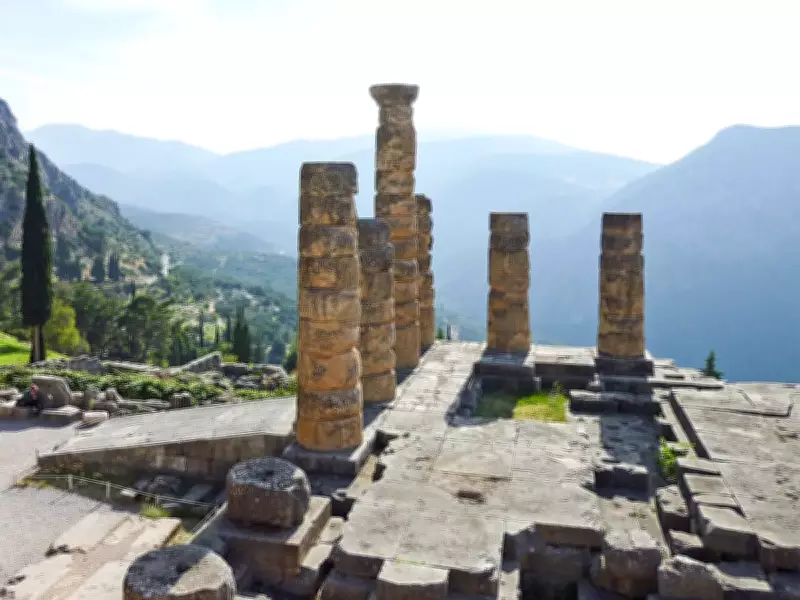
In the year 1892, a group of archaeologists, workers, and laborers gathered near the foot of Mount Parnassus. They were not conducting a routine excavation. Instead, they faced a far greater challenge. The village of Kastri, which stood atop part of the ancient sanctuary, was cleared and its residents relocated to allow excavation. This major clearance campaign enabled the French School of Archaeology to uncover the Sanctuary of Delphi between 1892 and 1903.
From Myth to Stone: Excavation of the Sanctuary of Delphi
The excavation uncovered far more than a single famous work of art. Most of the sanctuary was revealed during these major excavations, as noted in a Getty publication on artistry in bronze. Archaeologists uncovered a large sacred complex with temple remains, treasuries, and architectural fragments. These finds enabled researchers to reconstruct what had stood there for centuries. The dedications reflected the city-states that offered them, and the gifts became part of the sanctuary's physical fabric. Every one of these discoveries transformed Delphi from a name in an ancient text to a real, tangible archaeological site. The ruins of the sanctuary could now be seen where the oracle once stood.
Why Delphi is Important to the World
But Delphi was important for more than its architecture. In ancient Greece, the sanctuary played a central role in public and religious life. Other city-states used the sanctuary to display political power, while worshippers consulted Apollo for guidance. With the sanctuary visible again, it was easier to see why it had mattered so much in the ancient world. The excavation revealed how the sanctuary's architecture reflected religious belief, civic competition, and social status. In modern Greece, the event had enormous symbolic meaning. The Athenian Treasury, one of the major structures recovered during the great campaigns, stands as a testament to this.

The Oracle and the Pythia
The excavations renewed interest in long-standing questions about the priestess known as the Pythia, who was said to have spoken in the voice of Apollo. Ancient writings described a chamber where the priestess inhaled vapors from a cave and fell into a trance. Reconstruction of the area enabled researchers to test these theories against the geology and ruins. Peer-reviewed research indexed in PubMed supports the idea that intoxicating vapors might have played a major role at the site. This study agrees with the old tales about vapors and with the geological facts of the region. The study drew on several disciplines and presented Delphi as both an architectural marvel and a scientific puzzle about ritual practice.
A Milestone in Modern Archaeology
The excavations at Delphi were a turning point in nineteenth-century archaeology. They established a model for large-scale archaeological work across the region, using extended campaigns and clear-cutting to understand a complex sacred landscape. The workers who cleared the town were doing far more than moving debris. The excavations laid open the earth to reveal that settlements can hide, and archaeology can recover ancient landscapes. Delphi is a poignant image of how digging does not end a story but propels it out to the world at large.






