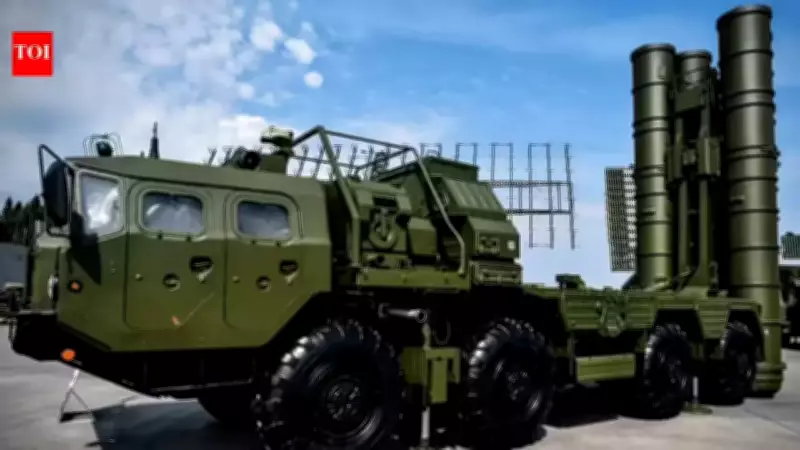
The long-awaited fourth squadron of the S-400 Triumf air defence systems, now called 'Sudarshan', has begun arriving in India from Russia via sea, significantly bolstering the country's missile defence capabilities. A source confirmed to TOI that the first batch has arrived, and deployment will follow once the complete system reaches India.
Strategic Importance
During last year's conflict in May, the Russian-made S-400 played a pivotal role in intercepting Pakistan-launched missiles. It also achieved the longest-recorded surface-to-air kill at 314 km by downing a high-value Pakistani surveillance aircraft. The system is part of a $5 billion contract signed in October 2018 for five squadrons. Three squadrons were delivered two years ago, while the remaining two were delayed due to the Ukraine war. With the fourth squadron now arriving in batches, the fifth is expected by November.
Deployment Plans
The earlier three squadrons are deployed strategically in the Punjab-Jammu region, Rajasthan-Gujarat region, and Sikkim sector, forming a triangular protective shield along India's western and northern borders. The fourth squadron is likely to be deployed in the western sector, given the threat perception from Pakistan after last year's conflict. A standard squadron comprises 8 to 12 mobile Transporter Erector Launchers (TELs), each carrying four missile tubes, providing 48 ready-to-fire missiles. With reload and support vehicles, a single squadron can field up to 128 missiles. Each S-400 unit has a detection range of up to 600 km and can engage multiple aerial threats, including fighter jets, cruise missiles, and ballistic missiles at various altitudes and distances.

Future Acquisitions
Impressed by the S-400's performance, the Defence Acquisition Council (DAC) has cleared the acquisition of five more squadrons of the Russian system. India is also developing an indigenous programme, codenamed Project Kusha, to create its own air defence systems capable of intercepting drones, missiles, and hostile aircraft at different ranges.