In 1972, during routine uranium testing in France on ore from Oklo, Gabon, French scientists discovered a curious phenomenon. The uranium ore contained unusually low levels of uranium-235. There were no signs of contamination or processing errors, as the mineral samples appeared ordinary. However, the ratio of elements in the rock was inconsistent with expectations for typical uranium deposits.
This unusual fact led scientists to one of the most bizarre discoveries in geology: traces that nature itself created and maintained its own nuclear reactor. Today, the Oklo deposit in Gabon is considered one of the best-known examples of a natural nuclear reactor on Earth.
The Clue Hidden Inside the Atoms
The essential factor in the discovery lay in uranium-235, the fissile isotope used in modern nuclear reactors. In the Oklo ore, there was less uranium-235 than expected. According to a review published in Radiation Protection Dosimetry in 2023, isotopic measurements later confirmed that sustained nuclear fission reactions had once taken place naturally at the site. The study describes Oklo as a unique natural example of reactor behavior preserved in geological history. Scientists did not immediately realize the significance of the finding. At first glance, it appeared to represent only a simple imbalance of chemical elements. Analysis showed that neutrons had passed through the uranium, and its nuclei had undergone the same fission process that occurs in nuclear reactors.

Scientific techniques such as mass spectrometry allowed researchers to study the isotopic composition of the ore in detail. Studies indexed through PubMed indicate that mass spectrometry can determine whether uranium deposits have undergone nuclear reactions.
A Reactor Created by Geology
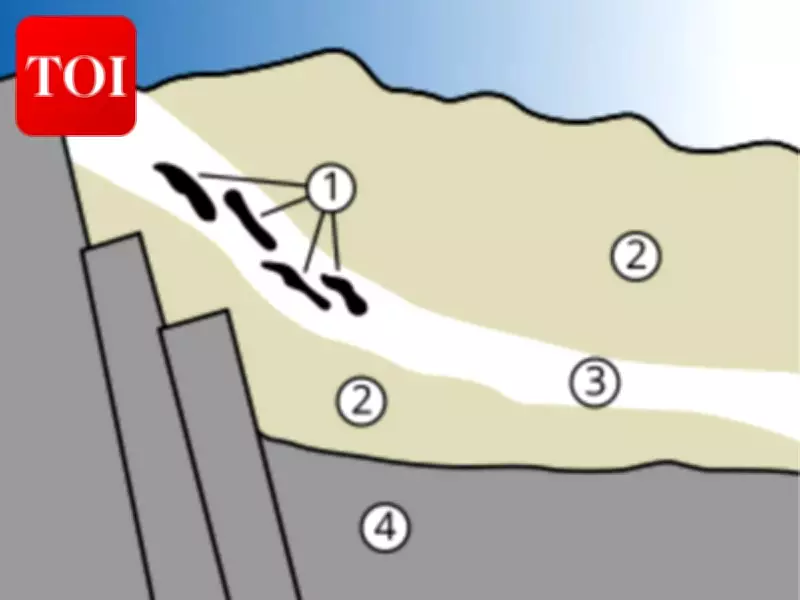
What made Oklo remarkable was not just its uranium content, but how the uranium behaved. Experts believe that around 1.7 to 2 billion years ago, conditions on Earth allowed self-sustaining reactions of fissile material to take place in the deposits. According to reports, Oklo continues to be scientifically significant as one such area that allows natural analogues of radioactive materials to be studied. Scientists use this site to study the migration of these radioactive materials over very long geological periods.
The significance of Oklo lies in how it changed from a mining area to a significant case study in science. It provided proof that natural nuclear reactions occurred on Earth even before human civilization. Researchers have also noted similarities between the behavior of the Oklo reactors and modern nuclear reactors.
Evidence That the Reactor Switched On and Off
It only got more interesting as subsequent isotope analysis was conducted on gases found encased in minerals from the area. In a published isotope analysis, scientists examined xenon isotopes associated with nuclear fissions in the Oklo and Okelobondo regions. The researchers proposed that the reactors worked in periodic pulses rather than one prolonged event. Based on their analysis, the natural reactors may have undergone an active stage lasting about half an hour, followed by an inactive period of 2.5 hours. This was seen as proof of the natural reactors operating in a self-regulating manner, depending on the physical conditions within the ore deposit.
In the interpretation of scientists, this natural reactor would be controlled by a mechanism where, upon rising temperatures, the system reached a condition unfavorable for further fission. After cooling, the system would once again initiate reactions. Scientists continue to investigate, but the implication was clear: the Oklo natural reactors were not static systems.
Why Oklo Still Matters Today
The Oklo area remains highly interesting for scientific investigation, as it opens new perspectives across multiple disciplines. Oklo offers great opportunities for studying ancient Earth processes, nuclear physics, and even the stability of radioactive compounds. Reportedly, Oklo is a fantastic place to investigate long-term geological disposal of radioactive substances. Scientists can test their models and assumptions concerning the behavior of nuclear material over geological timescales spanning billions of years.

In addition, Oklo reminds us that significant scientific discoveries sometimes result from seemingly insignificant discrepancies.