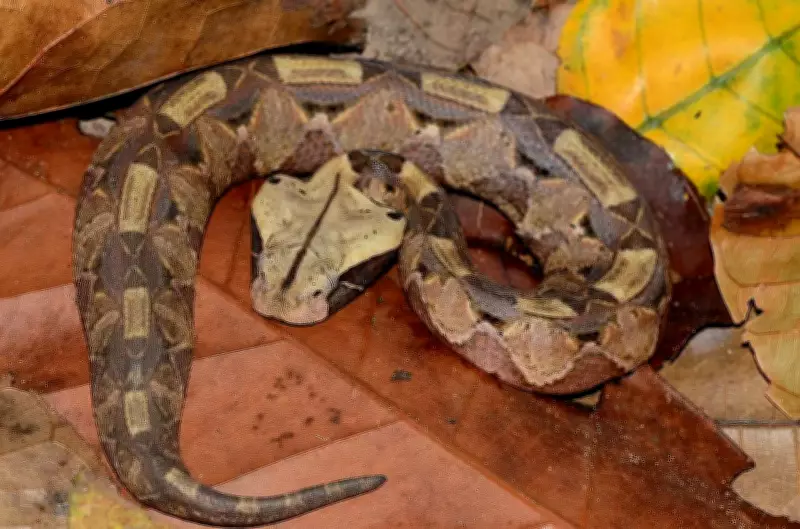
Some of the finest examples of evolutionary design can be observed in the shaded depths of tropical forest floors across Africa. Among these remarkable creatures is the Gaboon viper, a magnificent specimen of evolution and specialization. Famous for its extraordinary size and unique coloration, the Gaboon viper possesses a suite of natural attributes that make it legendary among snakes. This remarkable reptile has the longest fangs of any venomous snake and ranks among the largest true vipers in the world. Despite its formidable strength and weaponry, the Gaboon viper relies on stealth and patience for survival in the wild.
According to observations published by WorldAtlas, the advanced physiology of this reptile provides an amazing example of the balance between stealth and muscular power. Its entire body is adapted to blend into the constantly shifting shadows of the forest floor, enabling it to play a vital role in maintaining the stability of small mammal populations in this region. For ecologists, naturalists, and adventurous travelers, understanding the unique features of this special animal is essential for learning more about Africa's biodiversity.
Physical Characteristics and Evolution
Identifying a Gaboon viper is easy due to its heavy, leaf-shaped head and the intricate geometrical patterns on its body. The animal's coloration is an amazing mixture of brown, purple, and tan shapes that resemble dried leaves covering the jungle floor. As a result, the reptile blends so seamlessly into its environment that even its bulky body is not easily detected by passersby.

A major genetic investigation conducted by researchers and published in the scientific journal Kaupia under the title Phylogeny and Taxonomic Subdivision of Bitis based on molecular evidence revolutionized the understanding of these animals' evolutionary history. The study used mitochondrial DNA analysis and immunological distances to demonstrate immense genetic differentiation between eastern and western populations, leading to the identification of distinct evolutionary groups of Gaboon vipers. These findings paved the way for further taxonomic classifications, ultimately recognizing the West African population as a new species named Bitis rhinoceros.
Differentiating the two species depends on characteristic physical attributes on their faces. The West African Gaboon viper has huge nasal horns protruding from its snout and a distinct triangular-shaped mark between its eyes. In contrast, the East African species has small nasal horns and dark marks forming a black line from the eyes to the angle of the mouth.
Geographic Distribution, Habitat, and Feeding Behavior
The different variants of this bulky snake have distinct geographic ranges within the rich African landscape. The East African Gaboon viper is widely distributed in tropical and moist regions of Central and East Africa, while the West African species occupies a restricted range in the thick forests along the coast from Guinea to Ghana and Togo.
These vipers are purely terrestrial and show a strong preference for areas with high humidity and moisture. Such habitats include forest floors filled with ancient roots, dead logs, and deep leaf litter. These areas provide perfect camouflage for their hunting strategy. Rather than pursuing prey, they are ambush predators that lie patiently in wait. They remain perfectly still for several days until prey animals, such as rodents, ground-nesting birds, rabbits, and hares, happen to come near their coils.
Behavior and Defense Mechanisms
Slow, sedentary behaviors characterize the daily routine of the Gaboon viper. The species is primarily nocturnal, moving out from sheltering sites under ancient logs to search for new hunting grounds during the evening or nighttime. Due to their extremely slow metabolism during the day, they are docile and sluggish, preferring to remain still even when humans walk by.

However, if an intruder comes too close or interferes with them, they use an effective method of issuing non-violent warning signs before resorting to defensive aggression. In such situations, they do not back down but instead prepare for confrontation by raising the front part of their heavy bodies off the ground while emitting a deep hissing sound to fend off the threat. Although generally passive, they can strike very quickly, capable of launching half their body length in a fraction of a second.