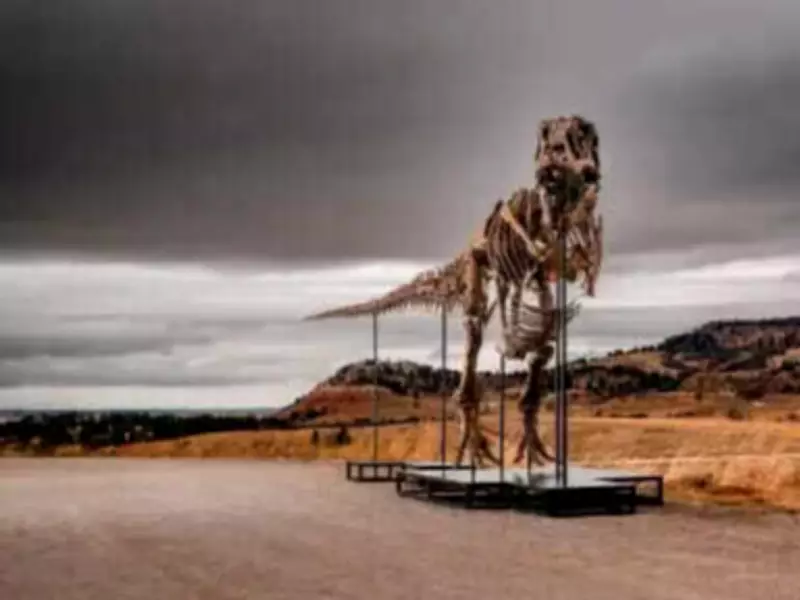
For anyone who has ever dreamed of owning a piece of natural history, a unique opportunity is about to arise. An enormous prehistoric skeleton, affectionately named Gus, will take center stage at Sotheby's New York natural history auction. This Tyrannosaurus rex specimen is remarkable for its size and preservation, standing twelve and a half feet tall and measuring approximately thirty-eight feet in length. Such a giant, mature apex predator is rarely found, making this one of the highest pre-sale estimates ever placed on a dinosaur fossil.
From a South Dakota Ranch to the Auction Block
The journey of this extraordinary fossil began at a cattle ranch in Harding County, South Dakota, within the renowned Hell Creek Formation, owned by the late Gary Licking. For years, the rancher discovered strange teeth and small bone fossils on his property before contacting the excavation team from Theropoda Expeditions to investigate further. The field team initiated their search across a massive six-and-a-half-thousand-acre section, locating the first remains in 2021. Tragically, the rancher passed away just one year into the complex extraction process, never witnessing the fully completed skeleton. In his honor, the team named the Tyrannosaurus rex Gus.
The extraction required three summers of dedicated fieldwork, with the team spending weeks at a time to uncover fossil pieces. After field research, three more years were devoted to laboratory work, where specialists painstakingly extracted, cleaned, and studied each element. In total, one hundred and eighty-three bone pieces were recovered, comprising approximately 63% completeness by bone count and seventy-five to eighty percent by total bone mass. Experts estimate its value between twenty and thirty million dollars, sparking debate among paleontologists about private ownership of such significant scientific finds.

Anatomy of a Prehistoric Titan
The upcoming natural history auction will showcase the structural and anatomical details that make Gus a uniquely complete specimen. According to Sotheby's, the skeleton belongs to a remarkably robust adult that lived approximately 67 million years ago during the Maastrichtian stage of the Late Cretaceous period. The exhibition-ready mounted skeleton features a massive fifty-four-inch skull, preserving eighty-two percent of its original cranial bones along with all six dentitions intact.
Beyond its size, the skeleton includes rare anatomical elements seldom preserved in fossil records. It boasts a very rare fossilized furcula (wishbone), a completely represented pelvis, and two well-represented hind feet—a level of structural completeness rarely seen in T. rex specimens. Additionally, the mount features thirty rarely discovered gastralia (belly ribs), precisely articulated across a custom steel armature that holds the ancient predator in an accurate predatory pose.
The surface of the fossilized bones tells a story of prehistoric survival and conflict. Forensic analysis reveals various pathologies, including clear tyrannosaurid bite marks on the skull bones and right dentary lower jaw, sustained either during combat or post-mortem scavenging. The axial skeleton also shows evidence of injuries that occurred during the individual's life, with fractured and completely healed bones visible across several ribs and belly elements.
A High-Stakes Event and Scientific Controversy
This unique item will be sold at a natural history auction run by Sotheby's. Due to its remarkable condition and completeness, experts have given a preliminary price evaluation of twenty to thirty million dollars. While the auction generates interest among private buyers, it also highlights an ongoing conflict within the scientific community. Many paleontologists express concern that once fossils are sold to private buyers, they become inaccessible for public scientific research, as they represent unique historical assets.
Despite these discussions, the public will have a unique opportunity to see this wonder from the dawn of time. Gus will be on display in the specialized galleries of New York starting July 1st, allowing visitors to acquaint themselves with the beast that roamed our planet sixty-seven million years ago, prior to the closing auction on July 14.

About the Author: The TOI Science Desk is an inquisitive team of journalists dedicated to curating captivating news, features, and articles from the ever-evolving world of science for readers of The Times of India. They strive to demystify scientific intricacies, making them accessible and engaging for all backgrounds.