

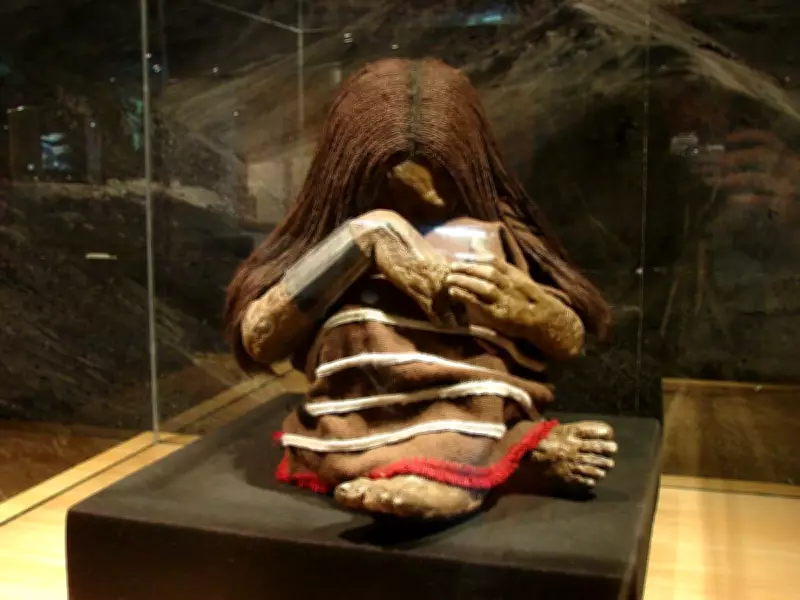
In 1954, a team of mountaineers climbing the glacier-covered Cerro El Plomo near Santiago, Chile, stumbled upon a discovery that would significantly influence the study of high-altitude Andean archaeology. Near the summit, they found remarkably well-preserved and frozen remains of an Inca child. Researchers interpret the body as a deliberate capacocha offering—a ritual sacrifice to mountain deities—rather than an accidental death.
An Unexpected Shock at the Mountain Top
Scientists were astonished at how well the burial and its artifacts were preserved. Because the high-altitude air in the Andes is extremely cold and dry, the child's body, as well as the clothing and grave items, were in excellent condition. The discovery offered a unique insight into a faith-based system of religion that rarely leaves such clear marks in the sands of time. The story quickly gained worldwide attention far beyond Chile. The boy was later transferred to the National Museum of Natural History in Chile and became an important specimen used for years of scientific study.
In a report indexed in PubMed, frozen graves at mountain summits are valuable for modern science because they preserve delicate information that normal graves lose over time. The cold conditions not only preserve bones but also hair, skin, and soft tissues, as well as delicate organic items buried with the deceased. Regarding Cerro El Plomo, it allows experts to study the boy not just as a historical relic but as a person who was an integral part of a state ceremony.

Why the Inca Climbed So High
To understand why a child was abandoned on an icy peak more than 5,000 meters above sea level, historians examine the religion of the Inca Empire. The ritual was a component of a formal, state-sponsored event known as the capacocha. These were not random deaths but significant events connected to important political events, successions, and attempts to thank gods during political turmoil. The El Plomo child was among the early finds that revealed a vast high-altitude ritual landscape.
An article published in the Proceedings of the National Academy of Sciences states that the Inca built more than 100 high-altitude ritual locations throughout the Andes, including some at awe-inspiring elevations between 5,200 and 6,700 meters. By constructing these temples on mountain tops such as Llullaillaco, Ampato, and El Plomo, the Inca Empire transformed dangerous and uninhabitable peaks into highly charged places of worship where state authority and religious devotion converged.
What the Ice Preserved
The research and scientific significance of the Cerro El Plomo discovery set the stage for contemporary archaeological techniques. Later excavations on different mountain ranges benefited from the latest technologies, but the El Plomo find showed that cold preservation can retain fine details about an individual's last days. In other high-altitude instances, researchers have used radiology and tissue analysis to discover what children consumed and how they were prepared for travel. Ice preserves evidence of changes in diet, ritual clothes, and the use of coca leaves, which were frequently offered to children during ritual preparation and to cope with extreme temperatures at the summit. The preservation at Cerro El Plomo was so ideal that it kept the human element of the ritual intact, providing the exact posture in which the child was placed to sleep.
A Discovery with Lasting Scientific and Cultural Significance
The Cerro El Plomo child is remembered as a key discovery that helped develop methods used in high-altitude archaeology. It showed that Andean summits were sacred ritual landscapes tied to imperial power. This discovery is among the most personal and informative pieces of archaeological evidence from the Inca. It blends the dramatic eruption of an unexpected mountain find with the profound sentimentality of a cherished human story. By preserving the altitude and ice, a moment of imperial faith was preserved in time, creating a link between modernity and a distant, sacred history.






