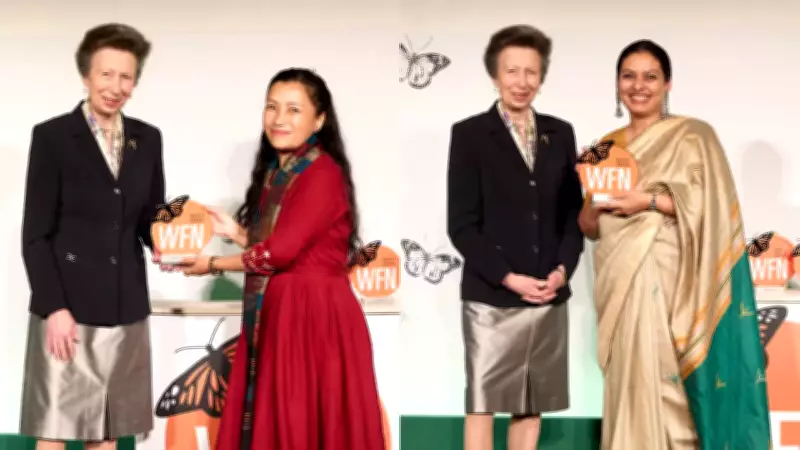
Indian conservationists Parveen Shaikh and Barkha Subba have won the prestigious Whitley Awards 2026, widely known as the ‘Green Oscars’, for their efforts to protect endangered species and fragile ecosystems in India. The award, presented by the UK-based Whitley Fund for Nature, honours grassroots conservation leaders from the Global South. Shaikh was recognised for saving the endangered Indian skimmer along the Chambal and Ganga river systems, while Subba earned praise for protecting the rare Himalayan salamander and wetland habitats in Darjeeling. Their community-led conservation projects, wildlife protection efforts, and biodiversity restoration work are now drawing global attention to India’s growing role in environmental conservation and endangered species protection.
Parveen Shaikh’s Mission to Save the Endangered Indian Skimmer
Over the years, Parveen Shaikh has been silently working by the rivers of India to conserve the Indian skimmer, a very rare bird species characterised by its distinctive orange bill. This river bird relies on a peculiar fishing method, but its numbers have sharply declined because of habitat destruction, pollution, sand mining, and changes in water flow. According to the Whitley Fund for Nature, today’s population of the Indian skimmer comprises no less than 90 per cent of its total global population. Shaikh’s conservation efforts centred around the Chambal river systems, where she launched the “Guardians of the Skimmer” community-based project focusing on nest guardians.
The positive results of Shaikh’s work have been significant: nest survival rates grew from 14 per cent to 27 per cent, and the number of local birds doubled, increasing from about 400 in 2017 to nearly 1,000 last year. In her comments regarding the conservation of the Indian skimmer, Shaikh stated: “It is small successes, like protecting a single nest, or a chick taking its first flight, which remind us that hard work pays off.” The Whitley Award funding will now help expand her conservation model to Prayagraj in Uttar Pradesh, where the Ganga and Yamuna rivers meet.

Barkha Subba’s Fight to Protect the Himalayan Salamander
In the wetlands of Darjeeling, Dr. Barkha Subba is fighting another important battle for the preservation of the rare amphibian known as the Himalayan salamander, often referred to as a “living fossil”. According to the Whitley Fund for Nature, threats to this species, which exists only in certain areas of India, Nepal, and Bhutan, include habitat destruction due to urbanisation, tourism, pollution, invasive alien species, and climate change. As the scientific adviser at the Federation of Societies for Environmental Protection (FOSEP), Dr. Subba dedicated herself to studying this species and restoring its breeding sites over several years. Her work includes wetland management, disease monitoring, control of invasive alien species, and conducting awareness programmes among tea garden labourers, local communities, students, and the general public.
Dr. Subba described the animal and the communities: “Meeting a salamander is like meeting an emissary from ancient evolution; a reminder of how long nature has existed and how fast we can destroy it.” She added, “I see communities fighting for what they hold dear. I see young people making choices to conserve, not to exploit.” Through the Whitley award, conservation efforts will be carried out in seven key breeding sites in the Darjeeling Himalayas.
What Are the Whitley Awards and Why Are They Known as ‘Green Oscars’?
The Whitley Awards rank among the most prestigious prizes awarded to conservationists worldwide. They are annually presented by the Whitley Fund for Nature at the Royal Geographical Society in London to conservationists who use science and collaboration to conserve biodiversity. This year’s ceremony was graced by Princess Anne, the charity’s patron. Sir David Attenborough, the broadcaster and environmentalist, also commended the work of the award winners. Attenborough stated, “From mountain ranges to caves, an extraordinarily diverse range of habitats. From rainforests to deserts, from mountain ranges to caves and from coral reefs to open oceans, we have to work now; the world won’t wait.” He added, “We need the work of Whitley Award winners to succeed and to help them to whatever extent possible.”

The Whitley Fund for Nature is dedicated to accelerating the efforts of grassroots conservationists and has provided financial aid to numerous conservationists worldwide since its inception by Edward Whitley. By including local communities as stakeholders in the conservation of natural environments, today’s conservationists are fighting biodiversity loss, climate change, land grabs, food insecurity, and water scarcity. For Parveen Shaikh and Barkha Subba, the honour is more than just a trophy; it is proof that grassroots conservation, local communities, and scientific commitment can still make a real difference at a time when biodiversity loss and climate pressures are accelerating worldwide.