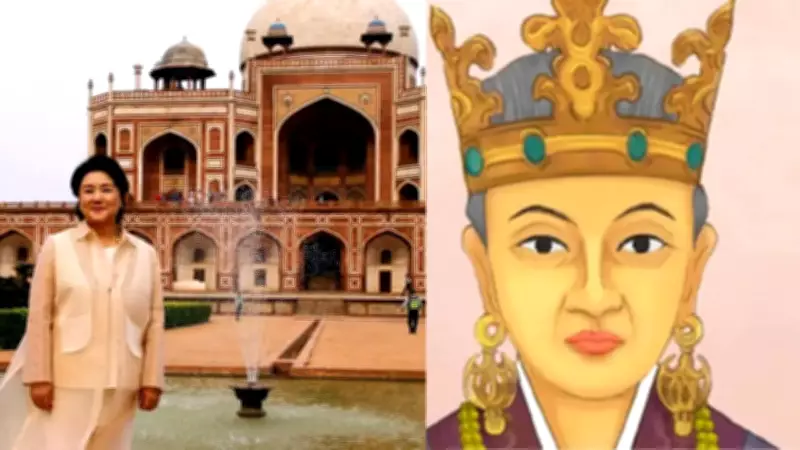
The story of an Indian princess believed to have become a Korean queen around 48 AD continues to captivate readers even today. According to ancient tradition, a young woman known as Suriratna is said to have departed from her homeland in India and sailed across the sea to the Korean peninsula. There, she is believed to have married King Kim Suro, the founder of the Gaya kingdom, and later became known as Queen Heo Hwang-ok. This account appears in old Korean texts such as the Samguk Yusa, which blends history and folklore. Some researchers connect her original land, called "Ayuta," with India's Ayodhya, although this remains a topic of debate.
Queen Heo Hwang-ok in Korean Tradition and Her Lasting Legacy
Queen Heo Hwang-ok holds a significant place in Korean tradition. She is commemorated as the queen who came from a foreign land and was integral to the royal establishment of the Gaya dynasty. In Indian folklore, the queen is identified as Suriratna, and the story is linked to the city of Ayodhya. It is said that she married King Kim Suro and bore him many children. Historians believe that both of them founded the lineage that persists today among some Korean families, such as the Gimhae Kim and Heo clans. These families proudly recount their ancestry, claiming descent from the queen. According to some accounts, their lineage includes members who lived in various parts of Korea. However, historians suggest that there is no concrete factual support for these assertions.
What Modern Historians Say About Its Historical Evidence
Most modern researchers and historians consider the legend of the princess to be a myth rather than historical fact. There is no solid archaeological evidence to confirm the existence of a princess who traveled from India to Korea. The term "Ayuta," mentioned in some old Korean documents, could refer to other places outside India. According to scholars, including those who have conducted research on Korean history, the legend may have evolved over many centuries. Imagination, symbolism, and the human desire to trace origins to a distant and remarkable place likely played a major role in the tale's development. While the story is widely cherished, its historical accuracy remains questioned due to limited evidence, and it is interpreted as a powerful cultural legend.