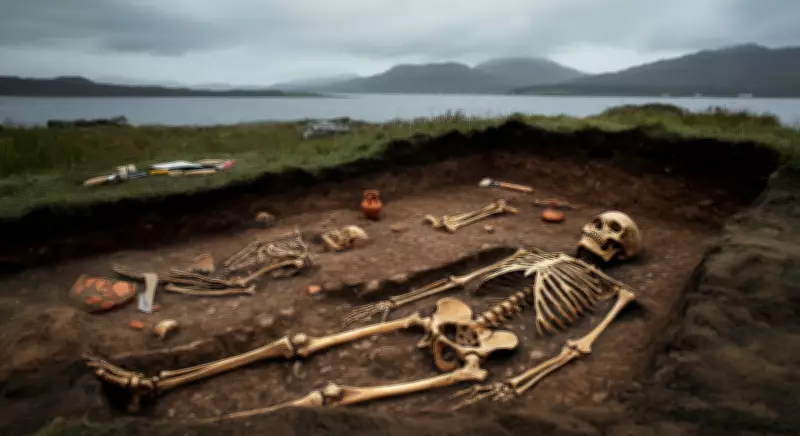
In the late 1990s, rabbits digging burrows in a remote corner of northern Scotland stumbled upon something extraordinary: a human skull buried beneath a pile of stones near Loch Borralie. When archaeologists later excavated the site, they uncovered the remains of two people who lived roughly 2,000 years ago, during Britain's Iron Age. Now, a new study has revealed that one of these skeletons, belonging to an adult woman, bears strange and deliberate modifications. Her brain appears to have been removed after death, and several of her bones were broken, sharpened, and possibly turned into tools. Researchers say these findings may point to a previously unknown funerary ritual, one that reveals just how complex Iron Age attitudes toward death and the dead really were.
Iron Age Skeleton Discovered Near Loch Borralie in Scotland
The discovery dates back to 1998, when rabbits burrowing into the ground near Loch Borralie, a lake close to Scotland's far northern Atlantic coast, exposed a human skull. Two years later, archaeologists arrived to properly investigate the site, recorded as part of the Highland Archaeological Research Framework, and found the remains of two individuals buried together beneath a stone cairn.
Radiocarbon evidence suggests the pair were laid to rest sometime between 50 B.C.E. and 70 C.E., placing their burial firmly within Britain's Iron Age. One set of remains belonged to an adult woman who was over 30 years old at the time of her death. The other belonged to a teenage boy of around 15.

For years, the burial sat largely unexamined in storage. But a fresh, detailed look at the woman's bones has now revealed that her body went through a series of unusual modifications after she died, changes that researchers say may represent a previously undocumented funerary tradition in Iron Age Britain.
How Researchers Found the Woman's Brain Was Removed After Death
In a new paper published in the journal Antiquity, researchers led by archaeologist Laura Castells Navarro of the University of York describe an unusual fracture at the base of the woman's skull, along with faint scrape marks on its inner surface.
Together, these clues suggest that someone deliberately opened the skull and removed the woman's brain using a sharp tool, sometime after she died. One possibility is that this was done to help preserve the skull, perhaps so it could be kept or displayed by the community. The researchers note, however, that cannibalism cannot be ruled out as an alternative explanation for the damage.
Not every expert is fully convinced the marks point specifically to brain removal, with some archaeologists outside the research team arguing only that the skull was clearly manipulated in some way after death, even if the exact purpose stays uncertain. Either way, Castells Navarro notes that whoever carried out these modifications would have needed an unusually detailed understanding of human anatomy for the period.
Why Were the Woman's Bones Broken and Whittled Into Tools?
The skull wasn't the only part of the woman's skeleton to be altered. According to the University of York, four of her long bones, taken from her arms and legs, were deliberately broken in half and then whittled down to sharp, tapered points on one end.
Researchers believe these modified bones may have been fashioned into tools of some kind, though their precise function remains unclear. What makes the find even stranger is what happened next: despite being broken and reshaped, the bones were carefully placed back into the grave in their original anatomical positions, as though the body had been deliberately put back together.
This combination, violent-seeming modification followed by careful, respectful burial, has puzzled researchers. In the paper, the team suggests the treatment could represent "purposefully abusive treatment" of someone considered an outsider or of low status within their community. At the same time, the effort taken to reassemble and bury her points toward a very different interpretation: that this woman was someone who commanded real respect from those who buried her.

What This Iron Age Burial Ritual Reveals About Ancient Scotland
The teenage boy buried alongside the woman tells a different story. His bones show no signs of similar modification, and DNA analysis indicates he was likely her maternal second cousin, suggesting the two were buried together for reasons rooted in kinship.
According to a statement from the journal Antiquity, the burial as a whole reflects a high level of care and attention from the living community, along with an ongoing relationship between the living and the dead. Rather than simply burying their dead and moving on, researchers believe Iron Age communities in this region exhumed bodies, modified certain remains, and reburied them as part of an extended connection with the deceased.
Genetic links also place this woman and boy in the company of other Iron Age individuals buried on Orkney, around 108 miles away, and on the Applecross peninsula, roughly 140 miles distant. This suggests that small maritime communities moved regularly along Scotland's northern coastline, carrying shared burial customs and possibly even people between far-flung settlements over generations.
While many questions about this particular ritual remain unanswered, the discovery adds a striking new chapter to our understanding of how Iron Age Britain treated, and related to, its dead.