

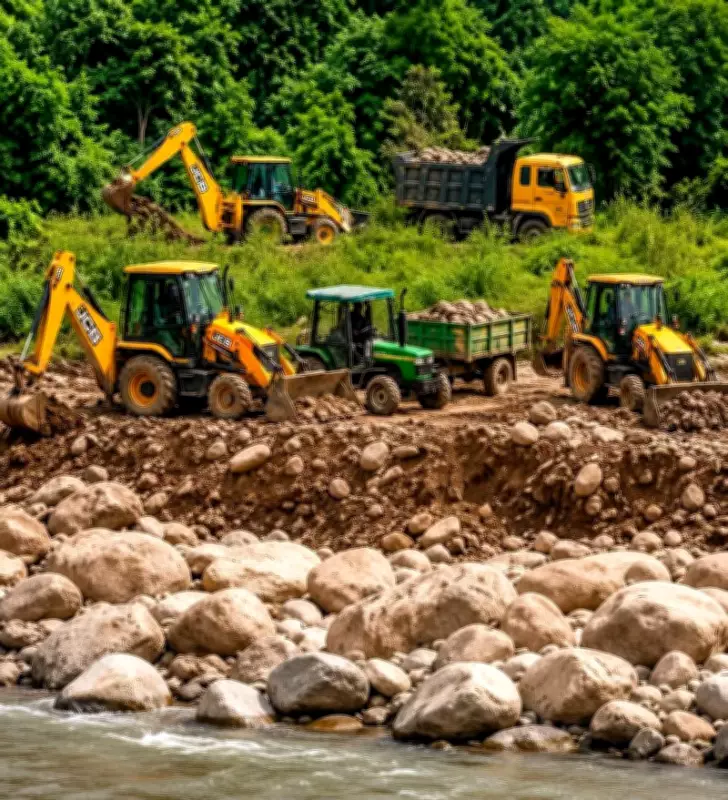
Residents of Jaisinghpur in Himachal Pradesh have expressed serious concerns over the rampant illegal mining and dust pollution in the region. Despite a complete ban imposed by the National Green Tribunal (NGT) and the state government on mining in the Beas river and its tributaries, large-scale illegal extraction continues unabated. The alleged lax attitude of the police and mining authorities has allowed unscientific mining to flourish over the past few years.
Heavy Machinery Used in Violation of Regulations
Heavy machinery, including JCB excavators, is openly used to extract sand, gravel, and stones from the Beas riverbed and nearby rivulets. This blatantly violates mining regulations that prohibit such machinery in riverbeds. Enforcement remains virtually absent, leading to significant losses in royalties for the cash-strapped state government. Local residents allege that senior authorities are aware of the situation but have taken little action to curb the illegal activity.
Past Efforts and Resurgence of Mining Mafia
During a visit to Jaisinghpur, several villagers told The Tribune that illegal mining had almost stopped a few years ago due to frequent police raids, vehicle impounding, and criminal cases registered under NGT and state government directions. However, they claimed that the lack of political and administrative will has enabled the mining mafia to regain control and resume large-scale operations in the Beas and its tributaries.

A senior official of the Mining Department stated, “The police and the Mining Department regularly conduct raids, impound vehicles, and impose penalties on violators.” However, he admitted that mining operators have increasingly shifted their activities to night hours and assured that fresh action would be initiated against offenders. Despite repeated attempts, the District Mining Officer could not be contacted for comment.
Threat to Infrastructure and Water Resources
Illegal mining is reportedly posing a serious threat to public infrastructure and water resources in the area. Dozens of drinking water schemes, electricity transmission lines, private properties, and government buildings are vulnerable due to indiscriminate excavation along the riverbed. Residents pointed out that during the last monsoon season, several transmission lines, cremation grounds, local roads, and village paths were damaged due to excessive mining. Percolation wells constructed by the Jal Shakti Department at a cost of nearly Rs 5 crore are also facing threats from continued excavation near the structures.
Officials of the Jal Shakti Department claim that deep trenches created by illegal mining have lowered groundwater levels in certain stretches of local rivers by nearly 10 to 15 feet. These rivers and rivulets serve as vital sources of drinking water for several supply schemes. The Executive Engineer of the Jal Shakti Department at Jaisinghpur has reportedly written several letters to the District Mining Officer and state geologists highlighting the issue, but no concrete action has been taken.
No Record of Mining Leases
Interestingly, local revenue authorities reportedly have no records regarding the exact locations and extent of mining leases granted in the area. Villagers alleged that many stone crushers were openly extracting minerals far beyond their leased boundaries, as most authorised mining sites had already been exhausted. As per NGT and state government guidelines, mining authorities are required to clearly demarcate leased mining areas with red flags or boundary markers to prevent extraction outside approved zones. The guidelines also prohibit mining within 100 metres of rivers, bridges, roads, and water bodies. However, no such markings were visible at the sites visited, making it easier for illegal operators to carry out mining activities unchecked.

Stone Crushers Flouting Pollution Board Norms
Villagers alleged that nearly 90 per cent of the stone crushers operating in the area were not complying with norms prescribed by the Himachal Pradesh State Pollution Control Board (HPPCB). These units are required to install water sprayers and fabric filter systems to control dust emissions. However, residents claimed that many operators had failed to follow the norms, posing serious health risks to local communities. Most stone crushers have been installed in populated areas and continue to operate round the clock without effective oversight from local authorities. Residents said the resulting dust pollution has adversely affected public health, with the elderly and children being the worst affected.
While interacting with The Tribune, local residents and panchayat pradhans said they had repeatedly written to the state Mining Department and the district administration, demanding action against the units so that villagers could live in a healthier environment. However, they alleged that no meaningful action had been taken and that the crusher units had now become a major health hazard in the area.





