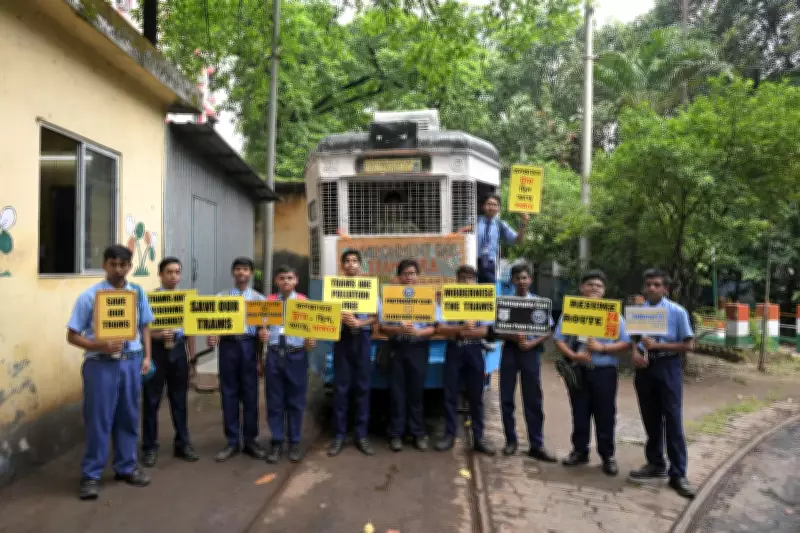
This World Environment Day, it was not merely about planting trees but about showing up. A diverse cross-section of Kolkata, including school students, NGO volunteers, writers, urbanists, and long-time tram activists, gathered at tram depots and along the tracks to transform a slow-moving tram into a fast-moving statement on climate action. As a decorated tram rolled across the city, the energy on the ground made one thing clear: for many here, sustainability is not symbolic but deeply tied to how the city moves, lives, and plans its future.
Trams: A Pollution-Free Alternative
Dr. Debasish Bhattacharyya, President of the Calcutta Tram Users Association (CTUA), was unequivocal in his support. 'Trams draw power directly from overhead electric lines and convert it into mechanical energy; there is no toxic residual waste,' he said, taking a pointed swipe at the electric vehicle industry's lithium-ion battery problem. 'Removing trams from Kolkata at this point would be a short-sighted and damaging decision.'
Pradeep Kakkar, Founder Member of People United for Better Living in Calcutta, backed him with data—or rather, the lack of it. 'Claims that trams slow down traffic are baseless. We filed an RTI asking for evidence. The response was zero.' His organization has taken the tram cause all the way to the Supreme Court. 'We do not see trams as heritage relics,' added Bonani Kakkar, the group's President. 'We have been fighting for them for years, not just on World Environment Day.'

Community Voices on Tram Revival
Closing routes like Ballygunge to Tollygunge has caused inconvenience, especially for senior citizens who rely on this affordable transport. Sumita Banerjee, a member of the Lake Lovers Forum, said, 'Trams are economical and environmentally sustainable, while many cities are reviving them, we are losing ours. That is why I felt it was important to be here today.'
GM Kapur, Director of INTACH, added, 'I am really happy to be part of this Environment Day initiative. It is encouraging to see people come together to talk about sustainability in such a meaningful way. Efforts like these not only raise awareness but also remind us that small, collective actions, like supporting eco-friendly transport, can make a real difference for the future.'
A Creative, Community-Led Push for Revival
The tram itself doubled up as a visual statement, blending reused materials with printed elements like old photographs—striking a balance between sustainability and storytelling. 'We were clear that we wanted to reuse as much as possible,' said artist Shreya Goswami. 'The idea was to create something with soul using what we already had.'
'This initiative is also about presenting trams to a new generation,' said Deyasini Roy of Placemaking India. Swati Mishra added, 'We want to build stronger public engagement and advocacy for trams and create more vibrant public spaces around them.'
For KSDS, the day blended tradition with collaboration. 'We have been planting trees every year for 19 years. This time, being part of this initiative makes it even more special,' said secretary Jayatipa Dasgupta.
The event underscored that trams are not just relics of the past but vital components of a sustainable urban future. The collective action on World Environment Day sent a clear message: preserving and promoting trams is essential for Kolkata's environmental and social well-being.