

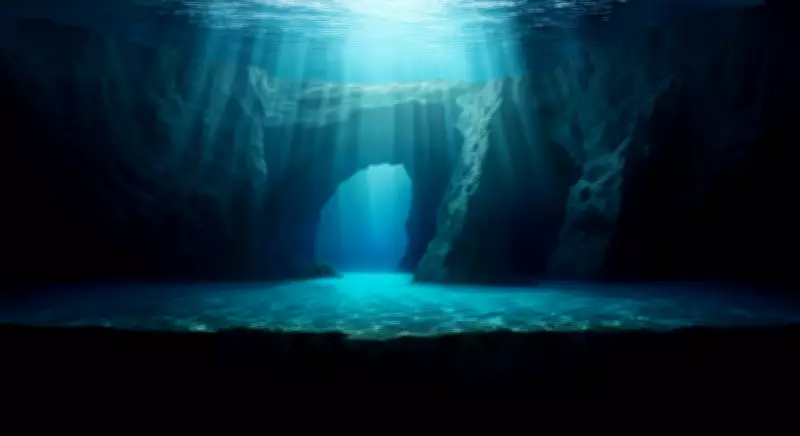
From above, the Chetumal Bay area in Mexico reveals a striking sight: a giant blue eye staring back from beneath the surface. Amid the white and creamy hues of the Yucatan Peninsula's coastline lies an extraordinary natural filter known as the Taam Ja' Blue Hole. However, its significance extends beyond its appearance. Recent studies have uncovered a depth that surpasses any other known blue hole.
Record-Breaking Depth
According to the study titled 'Recent records of thermohaline profiles and water depth in the Taam Ja' Blue Hole,' this pit reaches a depth of 420 meters (1,377 feet). To put this into perspective, the Trump Tower in Chicago would be completely submerged if plunged into it. Taam Ja' now holds the title of the world's deepest blue hole, relegating the Dragon Hole in the South China Sea to second place.
Challenges in Measurement
Sonar technology, typically reliable for measuring depths, faces challenges here. Taam Ja' is a karst formation, characterized by a tunnel system within the rock, akin to Swiss cheese. The water within consists of multiple layers with varying densities due to temperature and salinity changes. This causes sonar signals to bend and distort, making it difficult to ascertain the true depth. While the minimum depth is confirmed at 420 meters, the actual depth may be significantly greater.

A Time Capsule from the Stone Age
Beyond its depth, Taam Ja' serves as a scientific treasure. Its isolated depths lack water circulation, creating an environment with minimal oxygenation. This preserves ancient organic material, potentially offering insights into the Stone Age. Scientists have dubbed these blue holes 'ecological time capsules.' Organic matter at the bottom does not decompose, meaning Taam Ja' could house perfectly preserved fossils and microbial life unchanged since the last Ice Age.
Implications for Research
In the study 'First insights into an exceptionally deep blue hole in the Western Caribbean,' researchers explored how these formations function as time capsules. The near-zero oxygen levels prevent decay, making Taam Ja' a massive underwater museum. This could help scientists study ancient climates, evolutionary biology, and even the origins of life.
Future Exploration
Taam Ja' reminds us that remarkable discoveries await in our own backyard. It lurked along the Mexican coastline, waiting for scientists to measure its depth. Now that we have identified this gateway to the deep, we must await advances in technology to explore its full extent. The journey to uncover the secrets of Taam Ja' has only just begun.






