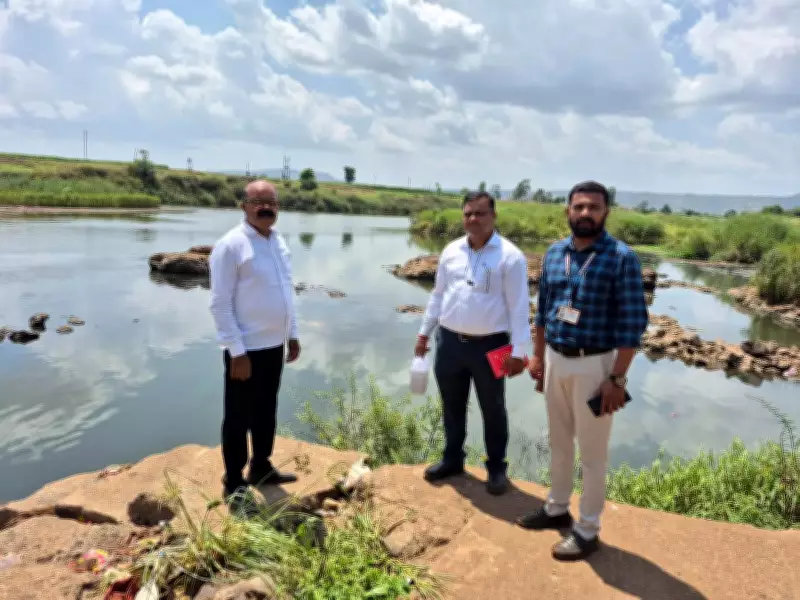
Kolhapur: Officials from the Maharashtra Pollution Control Board (MPCB) and the Kolhapur Municipal Corporation (KMC) conducted a joint survey of water pollution in the Panchaganga River on Monday. The inspection revealed significant contamination from untreated sewage and solid waste entering the river through various nullahs.
Activist Highlights Civic Negligence
Dilip Desai, a social activist from Prajasattak Samajik Sewa Sanstha, stated, "Due to the negligence of the civic body, sewage, plastic, and municipal solid waste are seen getting mixed from various nullahs directly into the river." He emphasized that the lack of proper waste management has exacerbated the pollution problem.
Key Findings of the Survey
The joint survey uncovered several critical issues. At the Dudhali area, the 17 MLD sewage treatment plant (STP) was operational but overwhelmed by the volume of sewage flow. Consequently, a large amount of untreated sewage had mixed into the Panchaganga River. Additionally, the Jayanti nullah, CPR nullah, and Siddharth Nagar nullah were observed overflowing, with their contents directly entering the river. A similar situation was noted at the Rajhans nullah and Ramanmala nullah.

At the Rajaram barrage, black-coloured sewage originating from Chhatrapati colony was found to emit a foul odour and contained plastic waste, solid waste, and clothes before mixing into the river. Furthermore, at the nullah near the brick kiln adjacent to the Tawde hotel entrance in Kolhapur city, sewage, plastic, and municipal solid waste were seen directly entering the river water.
Official Response and Next Steps
Ankush Patil, Regional Officer of MPCB, said, "The survey was carried out from 10 am to 4:30 pm on Monday. It was found that all the sewage from the nullahs flowing from the city is getting mixed with the river waters along with plastic, clothes, floating objects, and other municipal solid waste. Samples have been collected from various places, and upon the arrival of reports, further action will be initiated." The authorities are expected to take corrective measures based on the laboratory analysis results.