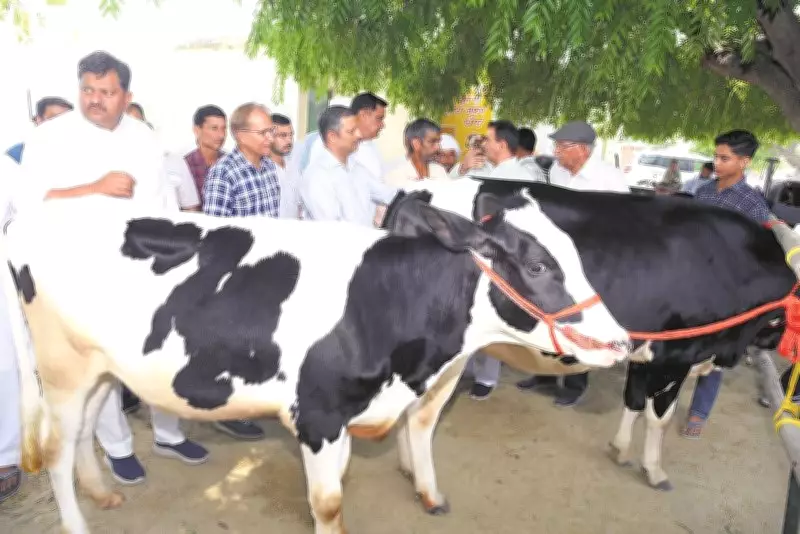
Scientists from the Indian Council of Agricultural Research-National Dairy Research Institute (ICAR-NDRI) in Karnal have successfully implemented a breed improvement model under the National Gokul Mission, a central government initiative under the Ministry of Fisheries, Animal Husbandry and Dairying. The project, which began in 2022, has delivered promising results in enhancing livestock quality and productivity, offering a blueprint for dairy farmers across India.
Project Scope and Implementation
The research project covered 100 villages in Uttar Pradesh's Muzaffarnagar district, where livestock farmers lacked access to high-quality germplasm and their animals had average production potential. Using artificial insemination technology and high-quality bull semen produced by ICAR-NDRI, the team conducted insemination on 39,803 cows and buffaloes. Of these, 16,200 animals became pregnant, with most having already calved.
The project was operated through NDRI's Farmer Service Centre at Lalukheri village in Muzaffarnagar. A team of 25 trained workers covered dairy animals across the 100 villages, with a total expenditure of Rs 3.75 crore funded under the Rashtriya Gokul Mission.

Key Outcomes and Benefits
The researchers reported that the progeny from the program exhibited improved growth rates and reached maturity earlier than conventional livestock. This translates to lower rearing costs and higher productivity for farmers. "Farmers can get better quality animals at lower costs and increased productivity would make dairy farming more profitable," the researchers claimed, emphasizing the potential of the findings to boost rural incomes.
Dheer Singh, Director of ICAR-NDRI, highlighted the model's replicability: "This model can serve as an example for other states. State governments can adopt this model to promote breed improvement programmes. This will boost milk production, strengthen the dairy sector and give new direction to the rural economy."
Impact on Dairy Sector and Farmer Incomes
Experts believe that large-scale implementation of this model could double farmers' income and strengthen India's position in global dairy production. The success in Muzaffarnagar demonstrates that targeted breed improvement, combined with artificial insemination and quality germplasm, can significantly enhance livestock yield. The project's completion marks a milestone in the Rashtriya Gokul Mission's efforts to conserve and develop indigenous bovine breeds while improving productivity.
The model's focus on low-cost, high-quality animal production is expected to make dairy farming more attractive and sustainable for smallholder farmers, who form the backbone of India's dairy sector. With 16,200 successful pregnancies and improved progeny, the initiative provides a data-backed pathway for national scale-up.