

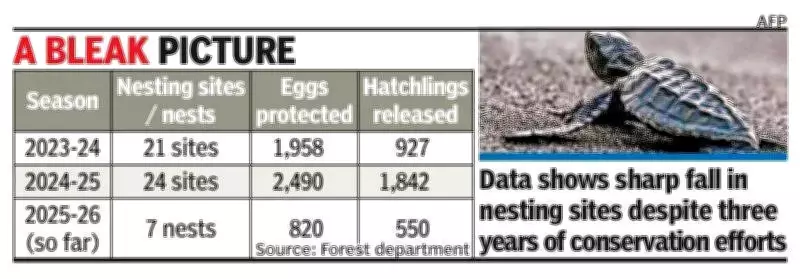
Mangaluru: Despite three years of dedicated conservation efforts, the nesting of endangered olive ridley sea turtles along the Mangaluru coast has witnessed a sharp decline of 60% this season, according to the forest department. The drop has raised concerns among wildlife officials and conservationists.
Nesting Statistics: A Comparative Analysis
In the 2024-25 nesting season, forest department officials identified nesting sites at 24 locations along the coast. A total of 1,842 hatchlings were successfully released into the sea after hatching. However, in the current 2025-26 season, only seven nests have been recorded so far. Out of 820 eggs protected, 550 hatchlings have been released under the supervision of the forest department. This represents a significant reduction in nesting activity compared to the previous year.
Conservation Efforts and Monitoring
The Mangaluru forest division, in collaboration with the Coastal and Marine Ecosystem Cell of the Mangaluru division, has been actively prioritizing turtle conservation along the coastline. During the nesting season, olive ridley turtles come ashore to lay eggs, and the nesting sites are identified and protected. Since 2023-24, conservation efforts have focused on three key beaches: Sasihithlu, Bengre, and Idya, where turtle activity has historically been higher.

Range Forest Officer (RFO) Rajesh Baligar provided detailed insights into the conservation work. He stated that in the 2023-24 season, 927 hatchlings were released into the sea. The first sighting of a nesting turtle in recent years was recorded on December 31, 2023, at Sasihithlu beach. That year, a total of 21 nesting sites were identified, yielding 1,958 eggs. From these, 927 hatchlings emerged and were safely released into the ocean.
Protective Measures for Nests
Speaking at the KDP meeting of the Mangaluru taluk, chaired by Mangaluru City North MLA Y Bharath Shetty on Tuesday, Baligar explained the measures taken to safeguard the nests. Nesting sites are secured with nets to protect the eggs from predators such as dogs and birds. Additionally, the sites are monitored using CCTV cameras and guarded by watchers around the clock until the hatchlings safely reach the sea. These efforts aim to maximize the survival rate of the vulnerable species.
The decline in nesting numbers this season is a cause for concern, and officials are investigating possible reasons, including changes in coastal conditions, predation, or environmental factors. Continued monitoring and adaptive conservation strategies will be crucial to reverse this trend and ensure the long-term survival of olive ridley turtles along the Mangaluru coast.






