

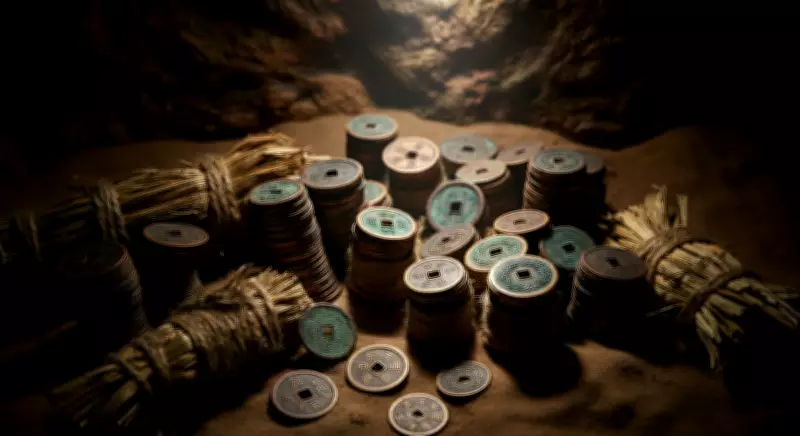
During routine excavations ahead of factory construction in Maebashi, a city in Japan's Gunma Prefecture roughly 100 kilometres northwest of Tokyo, archaeologists stumbled upon one of the most striking coin discoveries the country has seen in recent years. The site, known as Sosha Village East 03, yielded a staggering cache of more than 100,000 ancient coins packed tightly into an area just 60 centimetres high and one metre wide. The coins were found in 1,060 neat bundles of roughly 100 each, tied together using straw cords called sashi, spanning a jaw-dropping timeline, with the oldest piece tracing back to 175 BC and the most recent dating to AD 1265.
Ancient Japanese Coin Hoard Discovery: What Was Found at Maebashi's Sosha Village Site
Researchers from the Maebashi city government, who reported the find on November 3, 2023, have so far examined 334 of the coins in detail, identifying at least 44 distinct variants among them. The coins were found wrapped in straw matting before burial, with remnants of that original packaging still visible at the excavation site. The sheer scale of the find—over a hundred thousand pieces buried in a compact, deliberate arrangement—immediately pointed to intentional concealment rather than casual loss.
The site itself sits within a broader archaeologically significant zone spanning roughly one kilometre, which also includes the Sosha burial mounds, the San'o Temple Ruins, and the Ueno Kokubunji Temple. This wider area was a prominent hub of activity from the late Kofun period through the Ritsuryo period, suggesting the Maebashi region held considerable importance in ancient and medieval Japan long before this discovery.

Banliang to Song Dynasty: The Chinese Origins of Japan's Ancient Currency
The oldest coin in the hoard bears a Chinese inscription reading Banliang meaning "half ounce" and is a bronze piece that dates to around 175 BC. As the Metropolitan Museum of Art's collection records show, Banliang coins were among China's earliest standardised currency, initially introduced by the first Qin emperor around 210 BC and widely circulated through the Western Han Dynasty until they were replaced by Wu Zhu coins in 118 BC. The presence of such a coin in a Japanese hoard speaks volumes about the depth of ancient trade links between China and the Japanese archipelago.
The coins in the hoard predominantly trace their origins from China's Western Han Dynasty all the way through to the Southern Song Dynasty, with the most recent piece dated to AD 1265. Scholars note that Japan did not begin producing its own metal currency until the late seventh century, and even then modelled those coins closely on Chinese designs—square holes included. As Michigan State University historian Ethan Segal explained, those square holes were functional: strings would pass through them to bundle large quantities of coins together, with 100 coins per string being the standard arrangement. The Maebashi hoard appears to follow exactly that convention.
Japan stopped minting its own coins in the mid-tenth century, largely due to an inadequate copper supply and shifting economic conditions. In the gap that followed, Chinese coins, particularly those from the Northern Song Dynasty (960–1127), flooded into use across Japan. After the Jurchen nomadic group overran the Northern Song in the early 12th century, those Chinese coins lost domestic value, making them easier to circulate abroad. Segal noted it would not be surprising if a large portion of the Maebashi hoard turned out to be Northern Song coins for exactly this reason.
Why Were 100,000 Coins Buried? Scholars Debate the Purpose of Japan's Medieval Coin Hoards
The discovery at Maebashi is not an isolated phenomenon. Coin hoards, often quite large, have been found across Japan, and why they were buried has been a matter of scholarly debate for years. William Farris, professor emeritus of Japanese history at the University of Hawaii at Mānoa, told Live Science that two theories dominate: the hoards functioned either as a kind of bank for safekeeping wealth or they carried symbolic and possibly religious meaning. Farris personally leans toward the banking interpretation.

Segal, however, raises the possibility of wartime concealment—coins are heavy and cumbersome to carry when fleeing hostile forces, making underground burial a practical emergency measure. A third school of thought proposes that the coins were ritual offerings to the gods, though Segal notes there is no consensus among historians. The proximity of the Sosha Village site to what records suggest were the residences of influential medieval figures lends some weight to the wartime emergency theory, with researchers speculating the coins may have been hastily concealed during a period of conflict.
Kamakura-Period Warriors and the Timeline of Japan's Coin Burial
Dating the burial precisely is still premature, but the newest coin in the examined sample dates to AD 1265, placing it squarely within the Kamakura period (1185–1333), a transformative era in Japanese history when warrior clans took political control of the country through a shogunate system, while the emperor remained a figurehead in Kyoto. As the Metropolitan Museum of Art details, the Kamakura bakufu effectively established a binary system of governance: emperors reigned, but shoguns ruled, that endured for seven centuries.
Farris suggests the hoard's location and period point to warriors in the Gunma region as the likely depositors. Segal, however, urges caution. Only 334 of more than 100,000 coins have been examined so far, and later coins could still surface among the unanalysed bulk. He also notes that large coin caches of this kind more commonly date to the fourteenth century, when warfare intensified as the Kamakura shogunate began to collapse—a turbulent period when concealing one's wealth underground would have been a rational, even urgent, decision.
What Happens Next: Exhibition, Analysis, and the Scale of Japan's Coin Archaeology
Some of the coins from the Sosha Village East 03 site were put on display at the "Newly Excavated Cultural Artefacts Exhibition 2023" in Maebashi City's Otemachi district shortly after the discovery, allowing the public a rare look at the find before the full analysis was complete. The Maebashi City Cultural Heritage Preservation Division continues to oversee the work.
With over 99,000 coins still awaiting detailed examination, researchers expect the full picture of the hoard—its precise date range, the proportion of Chinese versus Japanese coins, and the likely identities of those who buried it—to become much clearer over time. What the discovery already confirms is that medieval Japan had a deeply layered relationship with money: coins moved across seas, changed hands across centuries, and were buried for reasons that mixed economic anxiety, political fear, and perhaps something more spiritual. Whether the Maebashi hoard turns out to be a warrior's emergency bank or a medieval offering, it is one of the most tangible windows yet into the economic life of ancient Japan.





