

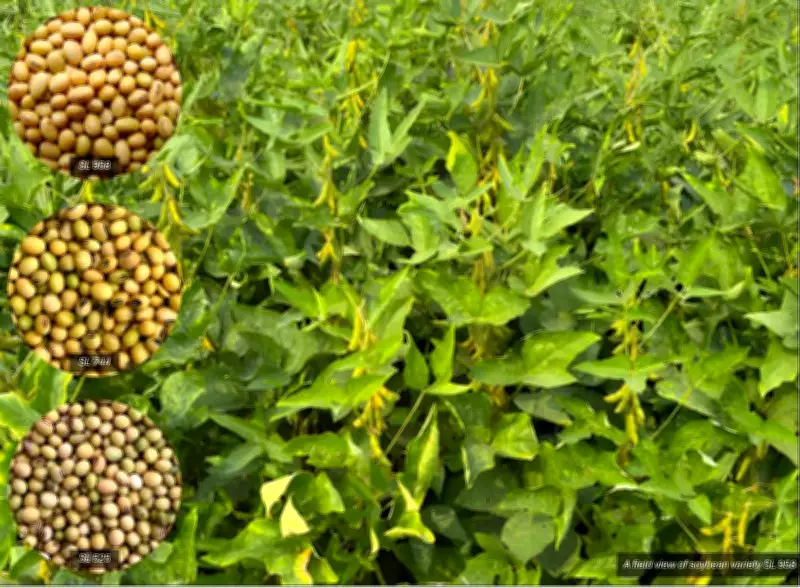
With the increasing burden on Punjab's agriculture sector and water resources due to the paddy-wheat cycle, there has been a growing chorus for shifting to alternative crop options. The state government has repeatedly urged farmers to break away from this cycle. In response, the Punjab Agricultural University (PAU) in Ludhiana has championed soybean as the “golden bean” that can help conserve water, enrich soil fertility, and diversify cropping systems.
Nutritional and agronomic benefits
PAU experts point out that soybean contains almost 40% protein and around 20% oil, making it a viable cropping option. Its yield potential ranges from 6.1 to 7.3 quintals per acre, positioning it as a sustainable alternative that fits well into the state's evolving agricultural landscape. Soybean requires less water compared to paddy, offers nutritional benefits, and improves soil health due to its leguminous nature.
Expert insights
“Soybean is not just another oilseed; it is a crop that can break the monotony of the paddy-wheat cycle and give farmers economic and ecological gains,” said Harpreet Kaur Virk, senior agronomist from the Department of Plant Breeding and Genetics, PAU. “Its lower water consumption makes it particularly relevant in view of the state's current scenario, where groundwater is depleting fast,” she added.

Vajinder Pal Kalra, agronomist from PAU, highlighted that the university has developed seed varieties. “We have developed and recommended varieties that are resistant to major diseases, like yellow mosaic virus and stem fly. With proper field preparation, seed treatment, and nutrient management, farmers can achieve yields of up to 7 quintals per acre,” he said.
Recommended varieties
- SL 958: Shining light yellow grains, highly resistant to yellow mosaic virus, average yield 7.3 quintals per acre.
- SL 744: Large light brown grains, resistant to yellow mosaic virus, average yield 7.3 quintals per acre.
- SL 525: Dull light brown grains with grey hilum, resistant to stem fly, moderately resistant to root-knot nematode, yield 6.1 quintals per acre.
Best practices for cultivation
Experts advise careful field preparation, including ploughing two to three times followed by planking. Seed rate and sowing should be 30 to 35 kg per acre in rows 45 cm apart. Weed management involves hoeing at 20 and 40 days or using pendimethalin/imazethapyr sprays. Irrigation requires 3 to 4 cycles, with the pod-filling stage being critical. Harvesting should occur when pods change colour to avoid shattering losses.
Soybean offers farmers a pathway to sustainable agriculture by conserving water, enriching soils, and opening new market opportunities. Adoption of recommended practices can ensure high productivity and profitability while aligning with the state's long-term ecological goals.






