

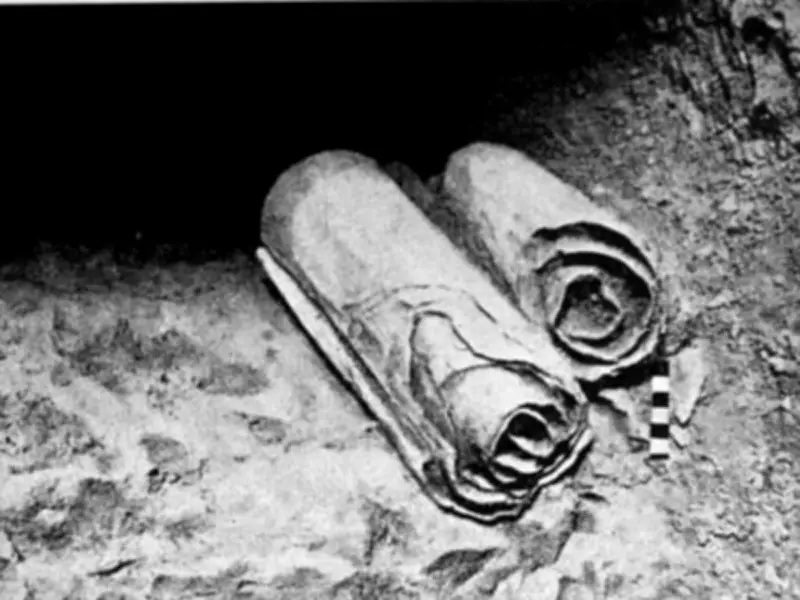
An unexpected incident in the Judean Desert offered a glimpse into a collection of ancient texts that had remained hidden for nearly 2,000 years. History is often shaped by careful planning and systematic excavation, but the story of the Dead Sea Scrolls began differently.
The Accidental Discovery
In the winter of 1946-47, while searching for a stray goat on the northwestern shore of the Dead Sea, a young Bedouin shepherd named Muhammed edh-Dhib happened upon a dark cave. According to accounts that have been immortalised in the archaeological canon, he hurled a stone at the opening, and instead of the soft thud of rock meeting the floor, he heard the unmistakable crack of pottery shattering. Intrigued, he scrambled inside. Inside the cave, he found jars containing ancient manuscripts that would later be recognised as one of the most important archaeological discoveries of the 20th century.
The Jars That Protected a Lost Library
Within the cave, he found several tall clay jars, most empty, but others containing linen-wrapped scrolls. At first, the find's importance went unnoticed, and the scrolls passed through local dealers until scholars finally came to examine them and realise the extraordinary age of the texts. The first discovery turned up seven scrolls, and in the years that followed, archaeologists and Bedouin alike discovered hundreds of other fragments and scrolls in the caves surrounding Qumran. According to the Library of Congress, discoveries made between 1947 and 1956 eventually produced thousands of fragments from eleven caves, transforming what began as an accidental find into a major archaeological project.

More Than 800 Manuscripts Discovered in the Desert
Reports note that around 900 manuscripts, represented by tens of thousands of fragments, were recovered from the caves between 1947 and 1956, written primarily in Hebrew, with several written in Aramaic and Greek. These include the biblical scrolls, legal texts, prayers, hymns, and apocalyptic writings. Some scrolls contain the oldest surviving manuscripts of books later included in the Hebrew Bible. The manuscripts offered scholars an unprecedented source of information about Jewish religious life during the Second Temple period.
Why the Desert Mattered
The caves lie in an exceptionally arid region near the Dead Sea, and the survival of the parchment and papyrus for centuries was due in part to the dry conditions in which they were stored. The scrolls are believed to have been written between the 3rd century BCE and the 1st century CE, which would make them amongst the oldest remaining written artifacts from the ancient Jewish world. Without the unique conditions of the Judean Desert, many of these texts would likely have disintegrated long ago.
A Discovery That Raised Questions for Decades
However, a study of the scrolls was barely underway before speculation and debate arose as to their origins and why they were concealed in caves in the first place. Archaeologist Roland de Vaux believed that he had found an answer through excavations at Qumran in the 1950s: he associated the caves and their contents with a small, Jewish religious community called the Essenes, who are thought to have lived nearby. Norman Golb of the University of Chicago argued that at least some of the manuscripts may have originated in Jerusalem and were hidden during periods of political upheaval rather than being produced by a single community at Qumran. These questions continue to spark debate among scholars, and that debate, along with the variety of texts discovered, makes the scrolls especially compelling.
How the Scrolls Changed Scholarship
Few archaeological finds could rival the impact of the Dead Sea Scrolls, as they had a major impact on biblical scholarship. In addition, the scrolls helped reshape scholarly understanding of ancient Judaism and early Christianity. They have since provided scholars with essential tools for researching ancient religion, history, language and literature. Instead of clarifying and providing all the answers about the ancient Near East, the scrolls broadened the number of questions that can be asked of them.

One Stone, One Sound, and a Discovery That Continues to Echo
Nearly eighty years later, we can picture a Bedouin shepherd, a cave, a flung stone, and the shattering sound of pottery echoing in the darkness. A seemingly ordinary moment while searching for a lost goat led to an extraordinary discovery that transformed scholarly understanding of ancient Judaism and provided valuable context for the world in which early Christianity emerged. Despite their antiquity and the enormity of what has been discovered about them, we still have more to learn about the Dead Sea Scrolls; their accidental discovery also shaped how scholars came to study them. A quiet moment in a remote desert brought to light a forgotten library and opened a new window onto the ancient world.





