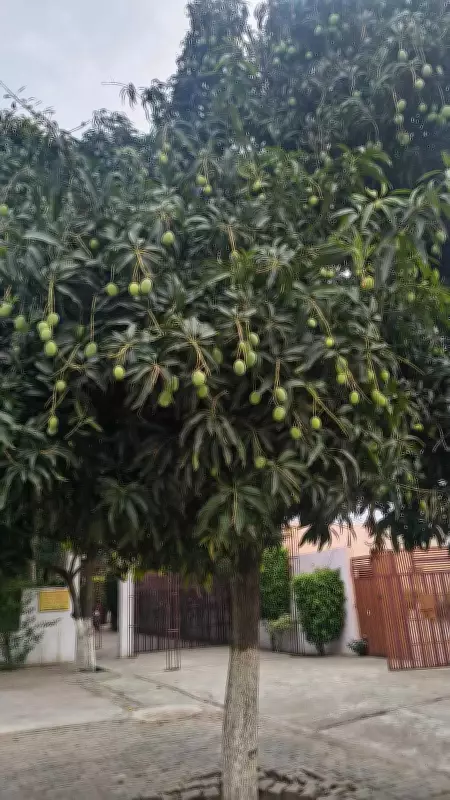
Bijnor: Unseasonal storms have destroyed nearly 30% of this season's mango crop in the orchard belts of Amroha and Bijnor districts, knocking down large quantities of raw fruit that growers said would otherwise have ripened for markets across India and export consignments abroad.
Since the start of summer, at least six dust storms, accompanied by gusty winds and light rain, have hit the region. The latest spell on Tuesday and Wednesday left heaps of green mangoes on the ground, causing significant losses for local farmers.
Expected Bumper Harvest Ruined
Farmers had expected a bumper harvest this year because flowering and early fruiting were timely, and weather conditions had remained favourable earlier in the season. However, the repeated storms dashed those hopes.

Mango grower Lokpriya Kakran said repeated weather changes had damaged the crop and raised concerns over lower production. “Continuous weather fluctuations have affected the mango crop, and production may decline this year. If the yield falls, mango prices in the market may go up,” he said.
Another grower, Mohammad Yunus, said adequate fruit quantity on trees was important for maintaining quality through the season. “When fewer fruits remain on trees, quality is also likely to be affected,” he noted.
Impact on Farmers and Markets
Growers said the fallen mangoes, because they had dropped before maturity, fetched poor prices and could mostly be used for pickles, chutneys or vegetable preparations. This represents a major financial blow to farmers who rely on the mango crop for their livelihood.
In Bijnor, mango groves are spread over 13,310 hectares across Mandawar, Kiratpur, Bijnor and Najibabad. The storm uprooted some trees and damaged orchards, with blossoms and raw fruit falling to the ground. The district grows varieties such as Dasheri, Chaunsa, Langda, Ratole and Bombay Green, and supplies mangoes to Delhi, Uttarakhand, Mumbai, Kolkata and Jaipur. Production in the district is over 1.5 lakh metric tonnes.
In Amroha, mango cultivation covers around 18,000-20,000 hectares, with annual production of around 3.5-4 lakh metric tonnes. Common varieties include Dasheri, Langra and Chausa. Growers said any further disruption could affect both domestic supply and export schedules, especially as exporters had already received orders for 250 tonnes from Dubai alone.
Expert Assessment
Agriculture scientist Dr K K Singh of Nagina research centre said inclement weather caused mango loss, though the overall damage could be assessed only later. “It is too early to assess the overall loss,” he said.
Experts warned that if the weather continued to affect production, mango supply could shrink and prices could rise sharply this season. Consumers may face higher prices for their favourite fruit as a result of the storms.
The damage underscores the vulnerability of agriculture to extreme weather events, which are becoming more frequent due to climate change. Farmers in the region are now hoping for stable weather to salvage what remains of the crop.