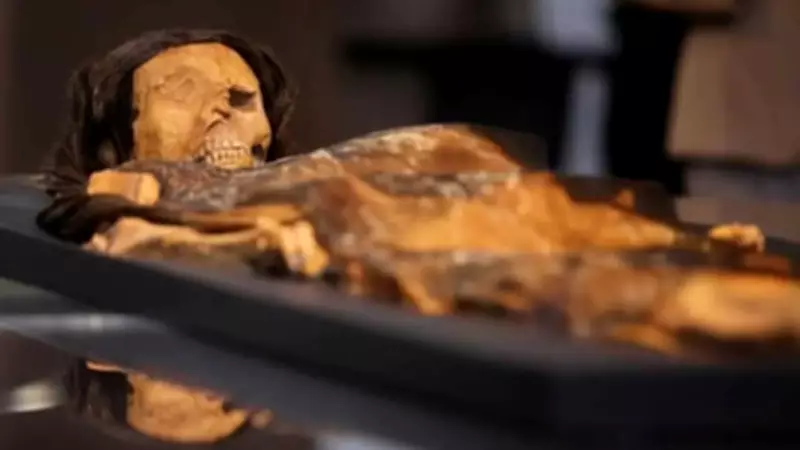
Across the dry coastal landscape of northern Peru, ancient ceremonial centres still emerge from the sand with surprising regularity. Some reveal traces of ordinary lives. Others open a window onto people who appear to have occupied a very different place in society. One burial uncovered at El Brujo, a large archaeological complex near the modern city of Trujillo, belonged firmly to the second category.
The woman had been dead for roughly 15 centuries. Yet parts of her skin remained preserved, allowing details rarely seen in ancient South American burials to survive. Fine tattoos stretched across her arms. Jewellery lay beside her. Weapons rested among funeral offerings. Nearby were the remains of a sacrificed teenager. Taken together, the objects raised questions that archaeologists had not expected to ask when the excavation began.
Mystery of the 1,500-Year-Old Tattooed Mummy in Peru
The tomb was discovered within a ceremonial area associated with the Moche, a civilisation that occupied Peru's northern coast long before the rise of the Inca. Their society flourished for centuries, building monumental temples, irrigation systems and thriving settlements across the region. The woman buried at El Brujo appears to have lived around AD 450. She died in her late twenties, according to examinations of the remains. Although her body had originally been wrapped within a large funerary bundle, enough soft tissue survived to preserve visible markings on the skin.

What immediately separated the burial from many others was the collection of objects surrounding her. Gold ornaments, finely crafted items and ceremonial equipment pointed to someone of considerable importance. This was not the grave of an ordinary community member.
What the Woman's Tattoos Revealed About Moche Life
Ancient tattoos are often difficult to study because skin rarely survives long enough to preserve them. In this case, the markings remained visible across both arms and other parts of the body. The designs were intricate and extensive. Archaeologists noted that they differed from tattoo patterns previously documented among Moche remains. Their exact meaning remains uncertain. They may have reflected status, religious responsibilities, family identity or roles within society. No written records survive to provide a clear explanation.
Even so, the tattoos offered something unusual: direct evidence of personal body decoration from a culture known largely through pottery, architecture and burial goods. They transformed the woman from an abstract historical figure into someone whose individual appearance could still be partially recognised after fifteen hundred years.
Why Weapons in Her Tomb Puzzled Archaeologists
The most puzzling objects were not the jewellery or ceremonial adornments. It was the weapons. War clubs and spear throwers appeared among the grave goods, items generally associated with male burials in Moche archaeology. Their presence created uncertainty about how the woman should be interpreted. One possibility was that she held a role connected to warfare. Another was that the weapons functioned as symbols of authority rather than practical tools. In many ancient societies, military imagery and political power were closely linked, and objects connected to combat could represent leadership as much as fighting ability.
Gold, Sacrifice and Status in a Moche Burial
The contents of the grave extended well beyond the weapons. Headdresses, gold jewellery, sewing needles made from precious metal, weaving equipment and stores of raw cotton were placed around the burial. Such objects reflected access to resources and skilled craftsmanship. They also hinted at responsibilities that may have combined ceremonial, political and economic authority.
A golden bowl covered the woman's face, while beads from necklaces remained scattered within the burial. The remains of a teenage girl found nearby added another dimension. Human sacrifice appears in archaeological evidence from several Moche ceremonial contexts, and the presence of the second individual indicated that the burial formed part of a larger ritual event.

The Woman Behind the Tattoos and Treasures
Examination of the skeleton revealed traces of healed changes in the bones linked to childbirth. At some point during her life, she had given birth at least once. Beyond that, many aspects of her story remain unknown. No obvious cause of death could be identified. Her daily activities, personal relationships and exact position within society are difficult to reconstruct with certainty. What survives instead is a collection of clues. The tattoos, the jewellery, the ceremonial objects and the unusual assortment of weapons all point towards an individual who occupied a distinctive place within the world of the Moche.