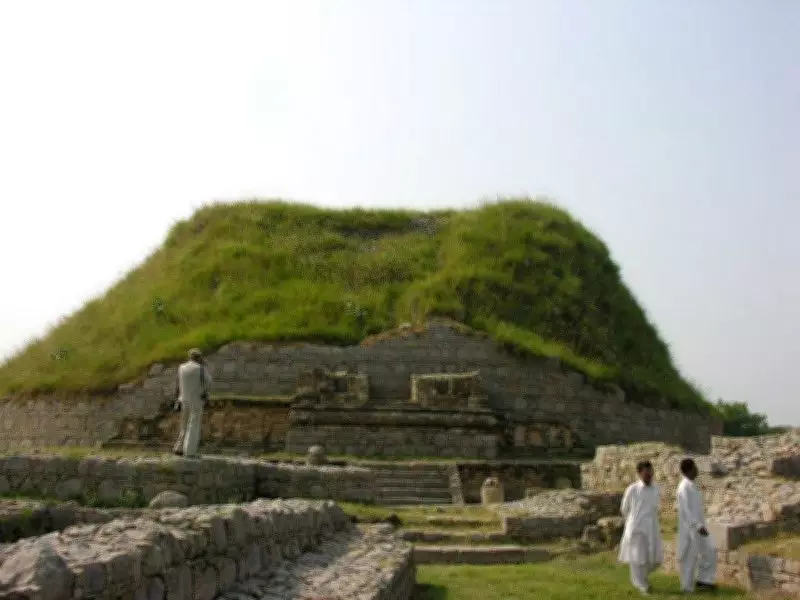
UNESCO has issued a stern warning to Pakistan over botched conservation work at the ancient Vedic-era archaeological complex of Taxila, a UNESCO World Heritage Site. The United Nations cultural arm condemned the use of modern cement and masonry by Pakistan's Department of Archaeology and Museums (DOAM), stating that these interventions have severely compromised the site's historic authenticity and integrity. According to the Pakistan-based newspaper Dawn, UNESCO has warned that unless immediate corrective measures are taken, Taxila could be placed on the List of World Heritage in Danger.
What Happened at Taxila
The controversy centers on unscientific restoration carried out at Sirkap and Mohra Moradu, two vital segments of the Taxila complex. Dawn reported that fresh masonry replaced sections of ancient walls, with polished, uniformly sized modern materials used instead of the original irregularly shaped ancient stones. The reckless intervention violated UNESCO's internationally accepted principles for preserving ancient monuments. The issue came to light in March after an alert visitor shared damning photographs with Pakistan's Permanent Delegate to UNESCO in Paris.
UNESCO's Response and Warning
During an emergency meeting with senior Pakistani officials, UNESCO raised serious objections, classifying the modifications as 'unnecessary interventions' that undermine the site's core historical authenticity. The agency explicitly reminded Pakistani officials of its zero-tolerance policy, noting that it had previously removed a World Heritage Site in Germany from the prestigious list, signaling that Taxila faces similar humiliation if conservation norms continue to be violated. On June 12, UNESCO conducted a joint technical inspection of the Taxila Museum and adjacent ruins alongside Pakistani ministries.

Impact on Pakistan's Heritage Ambitions
According to Dawn, officials warned that the controversy could weaken Islamabad's efforts to secure UNESCO recognition for 24 additional heritage sites, an exercise that has remained stagnant since 1997. Proposals for sites like the Buddhist ruins of Rani Ghat and the Scytho-Parthian location of Bhanbhore are expected to face severe blowback during upcoming UNESCO World Heritage Committee deliberations. The systemic failure highlights a disregard for Taxila's unique Vedic, Buddhist, and Greco-Buddhist heritage, which preserves remains from the Achaemenid, Mauryan, Indo-Greek, and Kushan periods.
Pakistan's Defense
Despite the visible damage, Pakistan's Punjab archaeology department has rejected the global criticism. Its Director General, Malik Zaheer Abbas, told Dawn that the claims of 'reconstruction' were inaccurate, maintaining that the interventions were conservation measures aimed at stabilizing vulnerable remains. Abbas added that there was 'no question' of reversing the work because it involved conservation, not rebuilding. However, local administrative elements conceded that the use of cement and modern masonry violated UNESCO's principles.
Historical Significance of Taxila
Taxila, located near Islamabad, was the heart of the historic kingdom of Gandhara and is chronicled in the Indian epics Ramayana and Mahabharata. Flourishing between the 6th century BCE and the 5th century CE, it was the world's earliest renowned seat of higher learning, associated with scholars like Chanakya and Charaka. The site was inscribed by UNESCO in 1980, and the current confrontation underscores Pakistan's inability to preserve a shared civilisational legacy stretching back to the Vedic age.