

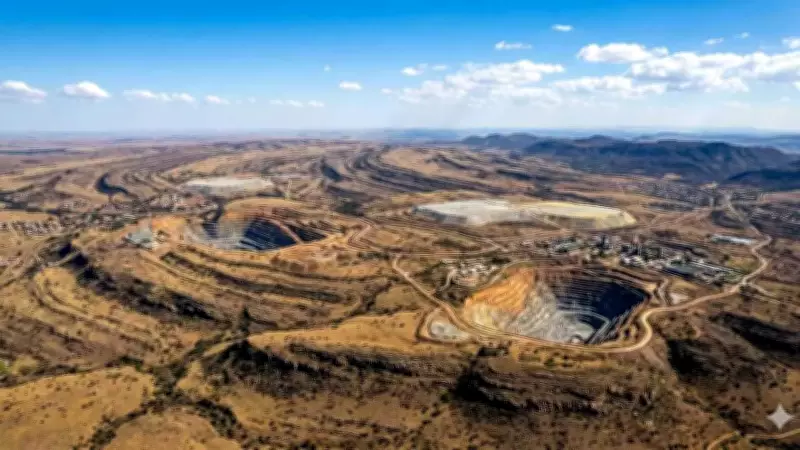
The Geological Marvel That Shaped a Continent
The Witwatersrand Basin in South Africa stands as one of Earth's most extraordinary geological formations, with origins tracing back approximately 2.7 to 3 billion years to the Archean Eon. This isn't merely a collection of mineral-rich debris but a fundamental pillar supporting both the geological understanding and economic framework of an entire continent.
A Legacy Written in Gold
Geological surveys and mining archives reveal a staggering statistic: roughly 40 percent of all gold ever extracted from our planet originates from this single sedimentary basin. The Witwatersrand Basin maintains the unique distinction of sustaining this monumental production level through more than a century of continuous mining operations, making it unparalleled in global mining history.
The Ancient River Systems That Created a Treasure
Contrary to appearances, the Witwatersrand Basin isn't simply a mountainous accumulation of precious metals. It represents a vast sedimentary structure composed of layered rocks that once formed ancient river networks, expansive floodplains, and shallow inland seas. Nearly three billion years ago, powerful rivers flowed across volcanic landscapes known as greenstone belts, gradually eroding mineral-rich rocks and transporting fragments downstream.

Gold, possessing exceptional density, settled rapidly within flowing waterways. Over immense timescales, it accumulated in gravel bars and riverbed deposits. As sedimentary layers stacked higher, these gold concentrations became deeply buried and compressed under tremendous weight. Intense heat and pressure eventually transformed them into durable conglomerates, effectively fossilizing the original river gravels within solid stone. Geologists classify this phenomenon as a palaeoplacer—an ancient placer deposit turned to rock.
Remarkably, many gold grains within these conglomerates still display rounded edges characteristic of water-tumbled particles. This crucial evidence ignited decades of scientific debate regarding the deposit's formation mechanisms.
Resolving a Century-Long Geological Debate
Throughout much of the twentieth century, researchers fiercely contested whether Witwatersrand's gold originated exclusively from ancient fluvial processes or if later hydrothermal fluids played the dominant role. Contemporary geochemical investigations have finally provided clarity.
University of Arizona scientists analyzed isotopic signatures within the basin's minerals, uncovering compelling evidence pointing to erosion from adjacent greenstone belts during the Archaean era. Their findings strongly support the palaeoplacer model, reinforcing the theory that rivers initially concentrated the gold, with subsequent burial and tectonic activity preserving and modifying the deposits.
The surrounding rock formations date between 2.7 and 3 billion years—a period when microbial life dominated Earth and complex organisms hadn't yet emerged. Consequently, the basin serves not only as an immense gold repository but also as a geological archive documenting early continental development.
The Birth of Johannesburg: Mining Transforms a Landscape
On September 20, 1886, President Paul Kruger officially opened the region for public mining, transforming a temporary tent encampment into a rapidly growing settlement. Authorities surveyed Randjeslaagte, a strategic wedge of government land situated between farms, auctioning the initial 600 stands on December 8. They named the emerging town Johannesburg, combining the names of surveyors Christiaan Johannes Joubert and Johann Rissik with "burg" denoting a town.
By early 1887, Ferreira's Camp—soon renamed Ferreira's Township—housed approximately 3,000 residents. A health committee established in November managed a three-mile radius around the central market square. Within a single decade, the population exploded beyond 100,000, cementing Johannesburg's status as a global mining epicenter intrinsically linked to the Witwatersrand Basin's ancient gold reefs.

Modern Mining Confronts Ancient Depths
As near-surface ore deposits diminished, mining ventures penetrated ever deeper into Earth's crust. The Witwatersrand Basin gained renown for pioneering some of the world's most advanced deep-level mining techniques. Multiple shafts now extend over four kilometers underground, where rock temperatures frequently exceed 50°C and extreme pressures increase risks of seismic rock bursts.
To maintain operations, mining corporations installed massive refrigeration systems to cool working environments and implemented robust, reinforced supports to stabilize tunnels. These formidable engineering challenges never halted production. For over a century, the basin continued yielding extraordinary gold quantities, even as annual outputs gradually declined from peak levels.
Formed during the Archaean era and first exploited in 1886, the Witwatersrand Basin remains responsible for approximately 40 percent of all gold mined throughout recorded history, according to industry records and geological assessments.
