

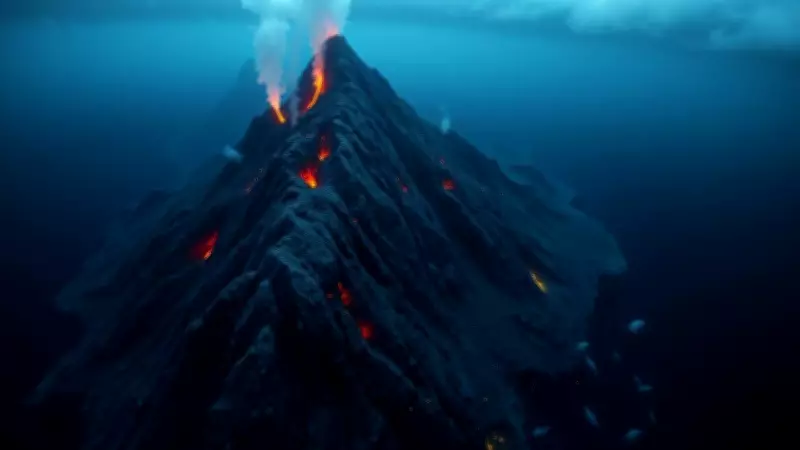
When thinking of magnificent mountain ranges, the image that instantly comes to mind is a stereotypical postcard of snowy peaks rising into the clouds. One imagines the rugged Rockies, the towering Himalayas, or the majestic Andes running across South America. Yet, we have been tricked by our vision. If you want to know the longest mountain range on Earth, you must venture into the deep ocean floor. The truth is that the longest range by far is an unseen system of underwater mountains that runs around the planet like stitching on a baseball. By measuring length rather than height, all well-known landmarks lose their bragging rights.
The Mid-Ocean Ridge System: Earth's Largest Geological Feature
The Mid-Ocean Ridge System spans an incredible 65,000 kilometers, cutting through the Pacific, Atlantic, and Indian Oceans. According to the National Oceanic and Atmospheric Administration, this system forms as tectonic plates pull apart at spreading centers. Magma rises from the mantle, cools in frigid seawater, and continuously builds a chain of volcanic mountains. Since this wonder is invisible without sophisticated sonar mapping, it receives less recognition than it warrants. If only land-based ranges are considered, the ranking changes dramatically.
Top 7 Longest Mountain Ranges by Length
1. The Mid-Ocean Ridge System
Total length: 65,000 kilometers. This continuous system is a dynamic volcanic chain that generates new oceanic crust daily.

2. The Andes Mountains
Second overall but longest on dry land, the Andes run about 7,000 kilometers along western South America, defining the continent's climate, culture, and geography.
3. The Rocky Mountains
Stretching roughly 4,800 kilometers across western North America, the Rockies form the continental divide, separating waters flowing to different oceans.
4. The Great Dividing Range
Australia's main highland spine spans about 3,500 kilometers along the eastern coast. These older, eroded peaks outstrip many more famous rivals in length.
5. The Transantarctic Mountains
Spanning 3,500 kilometers across Antarctica, this range separates East and West Antarctica, mostly hidden under thick ice.
6. The Himalayas
Famous for the tallest peaks on Earth, the Himalayas stretch about 2,400 kilometers across South Asia, proving height and length are different geological concepts.
7. The Appalachian Range
Completing the top seven at around 2,400 kilometers, the old Appalachians stretch through eastern North America. Though lower today, they hold a fascinating geological story as remnants of an immense ancient range.
Redefining Earth's Topography
Considering the undersea system brings new perspective: our biggest natural wonders may be invisible beneath the ocean. However, measuring these giants precisely remains challenging. NOAA notes that exact lengths vary depending on how researchers define start and end points. On land, mountains blur into foothills; underwater, the main ridge branches into fracture zones. Instead of ignoring this lack of precision, geologists embrace it, recognizing that these limits define an interactive system reflecting Earth's constant change. Our planet is larger than its surface, and we will never stop learning about the ocean bottom.
About the Author: TOI World Desk – A dedicated team of seasoned journalists and passionate writers tirelessly sifts through global events to bring you the latest news and diverse perspectives around the clock. With unwavering commitment to accuracy, depth, and timeliness, we strive to keep you informed about the ever-evolving world.






