

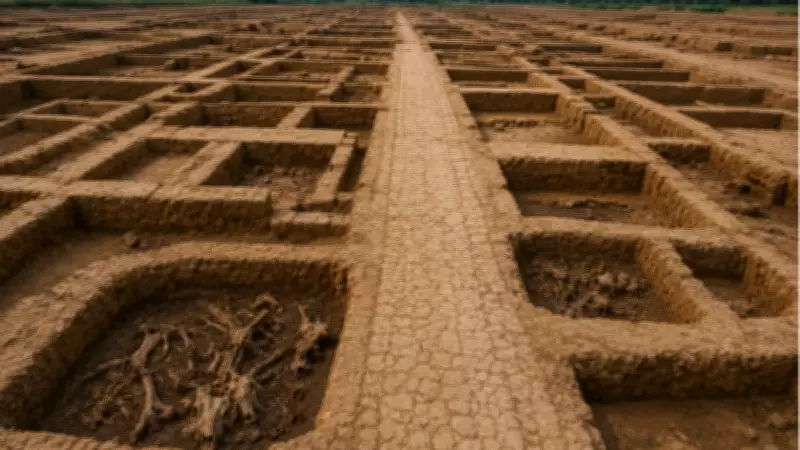
In Anyang, Henan Province, central China, archaeologists have been excavating a field for nearly a century. Beneath it lies Yinxu, the Ruins of Yin, the last capital of the Shang Dynasty (c. 1600–1046 BCE), the earliest archaeologically confirmed civilization in Chinese history. First excavated in the 1920s, Yinxu is a UNESCO World Heritage Site, yet only a tiny fraction of the ancient capital has been uncovered. The latest discovery: a massive north-south thoroughfare running 1.6 kilometers through the city's heart, its surface bearing dense wheel ruts from Bronze Age traffic, flanked by drainage ditches and embedded in a grid-pattern road network.
What Archaeologists Found
The excavation team, led by Niu Shishan of the Chinese Academy of Social Sciences, confirmed a main north-south road with a 1.6-kilometer drainage ditch and a surface covered in wheel ruts—evidence of sustained, heavy traffic over three centuries. Announced by China's National Cultural Heritage Administration on December 26, 2024, it is the longest urban road ever found at Yinxu and the longest preserved road of ancient China.
Grid Layout and Urban Planning
The road network forms a grid of at least three east-west and three north-south roads, with drainage ditches along main thoroughfares. Roads are classified into three levels based on width—main roads, streets, and alleys—indicating a deliberately planned hierarchy. This supports the Shang name for their capital, Dayishang (Great City Shang), as a planned urban center with infrastructure for moving people, goods, chariots, and animals.

Wheel Ruts and Chariots
The wheel ruts provide direct evidence of organized urban activity. Shang chariots were substantial—nearly four meters long and three meters wide—and the ruts show regular, heavy use over time. This suggests the road was a genuine artery for trade, administration, military movement, and ceremonies.
Sacrificial Pits and Western Zhou Settlement
Excavations also uncovered 48 sacrificial pits in six rows east of the western drainage trench, containing horse remains alongside human, cow, dog, pig, elephant, and bird sacrifices. Analysis of late Shang pits under King Zhou showed a 67% decrease in human bones compared to earlier periods, with animal bones more common. The remaining human bones came from prisoners of war, challenging the narrative of King Zhou as exceptionally brutal and suggesting evolving ritual practices.
A 20-acre settlement from the early Western Zhou Dynasty (11th century BCE) was also found—the largest such settlement at Yinxu. This indicates that after the Zhou defeat of Shang around 1046 BCE, the site was occupied and repurposed on a substantial, organized scale.
Significance for Ancient Chinese History
Yinxu has been foundational to studying early Chinese civilization. It yielded the tomb of Fu Hao, the warrior queen, and thousands of oracle bones with the earliest Chinese writing. Designated a UNESCO World Heritage Site in 2006, the site's earthen roads are notoriously difficult to identify, slowing mapping for decades. This new discovery underscores how much remains to be uncovered.
The findings were announced by China's National Cultural Heritage Administration and reported by Xinhua. Academic documentation is maintained by the Chinese Academy of Social Sciences Institute of Archaeology.






