

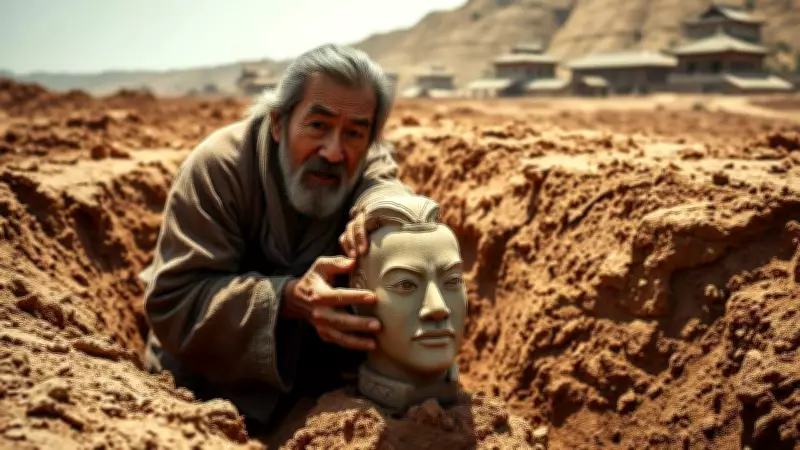
In 1974, a severe drought struck the province of Shaanxi in China. Farmers in the region, desperate for water, began digging a well on the hills around Li Mountains, not far from Xi'an. To their astonishment, instead of water, they unearthed fragments of red stones that resembled human figures. These fragments were not just broken ceramics; they were the first pieces of a magnificent puzzle that had remained hidden underground for over 2,200 years. Unaware of the historical significance, the farmers continued their daily harvesting, oblivious to the fact that they had uncovered the top layer of a burial chamber far more complex than anything ever imagined by humans. Their quest for irrigation water had led them directly to the silent guardians of the First Chinese Emperor, Qin Shi Huang.
The Frozen Ghost Army
The magnitude of the discovery is difficult to comprehend. As further studies were conducted at the site, its true nature gradually became clear. According to the UNESCO description of the Mausoleum of the First Qin Emperor, an entire city was constructed to serve as his mausoleum. Within it lies a lifelike army of clay figurines representing infantrymen, archers, charioteers, and horsemen. What makes this discovery unique and qualifies it as a piece of ancient art is the individuality of each soldier. Every face is distinctive, with unique facial expressions and hairstyles, indicating that they were modeled after real people who served in the emperor's army. The perfection of craftsmanship is evident, designed to provide the emperor with a strong army to protect him in the afterlife.
The pits resemble a vast underground dormitory or, better yet, an underground stone city. As an article in Smithsonian Magazine notes, new discoveries are being made continuously. Each year, new brightly colored sculptures are unearthed. Crucially, these figures are found with bronze weapons that can still cut through cloth and bone. This accidental discovery revealed the vast underground mausoleum of Emperor Qin Shi Huang, containing a lifelike army of uniquely crafted clay soldiers. The find, made while seeking water, unexpectedly uncovered a significant historical legacy.

From a Farmer's Tool to a Marvel of Wonder
There are few historical events that serve as better examples of how ordinary actions, like digging a well, can radically change our understanding of the past. Before 1974, the mausoleum of Emperor Qin Shi Huang was not widely known outside China. Only scant information hinted at its existence, leading to a discovery that astonished the world. While exploring these open pits, one cannot help but be fascinated by the precise arrangement of the clay figures. These rows lead us back to the third century BCE, forming an intriguing link to the past. Through no design of their own, these farmers, fighting for survival during a drought, created an invaluable legacy for posterity. In doing so, they remind us that history is not confined to books but can be found in the struggles of everyday life.
The importance of exploration combined with caution is emphasized here. These artworks were originally painted with bright colors that would peel off instantly upon exposure to the atmosphere. Therefore, scientists had to be creative in their techniques to preserve the fragile 'blush' of the army. This ensures that the army discovered by lucky farmers in the 1970s remains preserved for generations to come.






