January 2, 1985, marked a significant shift in Bangladesh's political landscape as the military-led government of President Hussain Muhammad Ershad took major steps to reshape the nation's politics.
Ershad Lifts Ban and Launches New Political Front
On this day, the government of Lieutenant General Hussain Muhammad Ershad officially ended a ten-month-long prohibition on open political activities. The ban, which had stifled political discourse, was lifted to allow a controlled return to party politics.
Simultaneously, a new political entity was launched with the direct backing of President Ershad himself. This national party was not formed from scratch but emerged from the merger of five distinct pro-government parties. These groups had already been participating in Ershad's cabinet, holding various ministerial portfolios. The consolidation was seen as a move to create a unified political vehicle to support the President's agenda and governance.

Opposition Reaction and Regional Unrest
The move by Ershad's government did not go unchallenged. Opposition political parties, critical of the military regime, swiftly announced plans to observe a six-hour general strike on January 5, 1985. This was a direct protest against the government's actions and the political environment.
Meanwhile, political violence erupted in the port city of Chittagong in southeastern Bangladesh. Press reports confirmed that one student was killed and six others were seriously wounded in a clash. The incident involved a group of Islamic fundamentalists and student supporters of the main opposition party, the Awami League.
Parallel Events in India and Sri Lanka
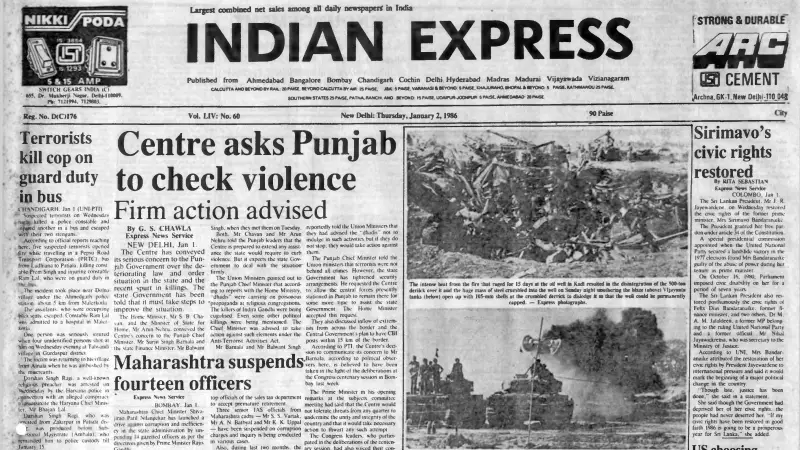
On the same day, in neighboring India, a separate incident of violence unfolded in Punjab. Suspected terrorists killed a police constable named Prem Singh and injured another, Ram Lai, on a PRTC bus traveling from Ludhiana to Patiala. The assailants, who were seated at the back of the bus, opened fire and escaped with the two sten guns of the constables.
In Sri Lanka, a major political development occurred as President J R Jayewardene restored the civic rights of former Prime Minister Sirimavo Bandaranaike. She had been found guilty of abuse of power by a special commission after the 1977 elections, leading to a seven-year civic disability imposed by Parliament on October 16, 1980. President Jayewardene granted her a free pardon under Article 34 of the constitution. Bandaranaike, however, stated that the restoration was a result of international pressure and would signal the start of a major political change in the country.
These events from January 2, 1985, collectively paint a picture of a turbulent South Asian region, where political maneuvering, violence, and the restoration of rights were defining the course of history.