

Asteroid Apophis' Historic 2029 Earth Flyby: A Scientific Opportunity
In April 2029, the asteroid Apophis will make an extraordinary close approach to Earth, passing at a distance that seems almost fictional on paper. Approximately 32,000 kilometers from Earth's surface, this proximity places it within the orbital region of many geosynchronous satellites, which typically reside around 36,000 kilometers up. This event, scheduled for April 13, 2029, has captured global attention, not due to danger, but because of the unprecedented scientific opportunities it presents.
No Impact Risk, But Unprecedented Proximity
NASA has definitively stated there is no known impact risk from Apophis for at least the next century. Following its discovery in 2004, initial concerns about a potential collision were quickly dispelled through extensive radar tracking and long-term observations. The asteroid's orbit is now precisely mapped, confirming it will safely pass by Earth without threatening people, infrastructure, or satellites. However, "safe" does not mean uneventful. A 340-meter space rock passing this close is a rare celestial alignment, an occurrence not often witnessed in recorded history.
Characteristics of Asteroid Apophis
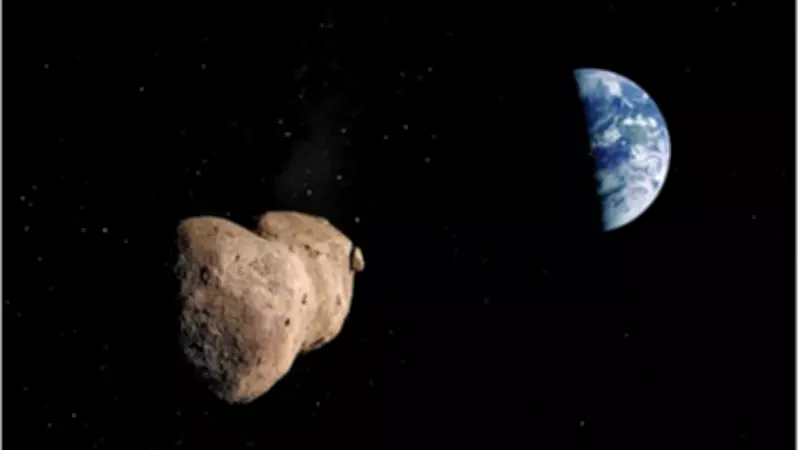
Apophis is not a perfect sphere but an irregular, elongated body, often described as peanut-shaped. With a mean diameter of about 340 meters and a longest axis stretching to roughly 450 meters, it is classified as a stony asteroid composed primarily of silicate rock mixed with metals like iron and nickel. This composition marks it as a primordial remnant from the early solar system, formed around 4.6 billion years ago.

Originally from the main asteroid belt between Mars and Jupiter, gravitational interactions pushed it into an Earth-crossing orbit, categorizing it among the Atens group of near-Earth asteroids. Its rotation is particularly intriguing: it spins once every 31 hours with a slight wobble, a phenomenon scientists term non-principal axis rotation. This unstable-looking motion is actually natural for many irregular asteroids.
The 2029 Flyby: A Natural Experiment
The 2029 encounter is far more than a simple pass-by. Earth's gravity will exert a noticeable influence on Apophis, slightly pulling and stretching it, and altering its solar orbit. Expected outcomes include:
- A shift to a larger orbit with a longer orbital period.
- Potential changes in rotation speed due to gravitational interactions with its uneven shape.
- Minor surface movements, such as sliding of loose material, offering insights into the asteroid's structural integrity.
These subtle effects transform Apophis into a valuable natural experiment, allowing scientists to observe how rocky bodies behave under planetary gravity in real time.
Global Scientific Preparations
A coordinated global effort is underway to study this event. Ground-based telescopes will monitor brightness changes during rotation, while radar systems will map its shape and motion with high precision. Space agencies are also actively involved:
- NASA's OSIRIS-APEX spacecraft, repurposed from the OSIRIS-REx mission to asteroid Bennu, is en route to observe Apophis post-flyby, studying surface and orbital changes.
- The European Space Agency's Ramses mission plans to rendezvous with Apophis and accompany it during the close approach.
Together, these missions will provide a rare multi-angle view of a near-Earth asteroid under planetary influence. Even without specialized equipment, Apophis may be visible from parts of the Eastern Hemisphere under ideal conditions with clear skies.
Discovery and Naming
Apophis was first detected in 2004 by astronomers at Kitt Peak National Observatory. Early orbital uncertainties briefly raised impact concerns, but these were later ruled out. The name "Apophis" derives from the Greek form of Apep, an ancient Egyptian deity associated with chaos and destruction. While popular culture has embraced the name, its origins are mythological, reflecting the asteroid's initial perception as a potential threat.

Significance of the Flyby
Apophis represents more than just another asteroid passing through space. It offers a unique chance to study a large near-Earth asteroid up close without leaving Earth's orbit. As a time capsule from the solar system's formation, it provides insights into planetary origins and dynamics. This event underscores the importance of astronomical observation and international collaboration in advancing our understanding of the cosmos.





