

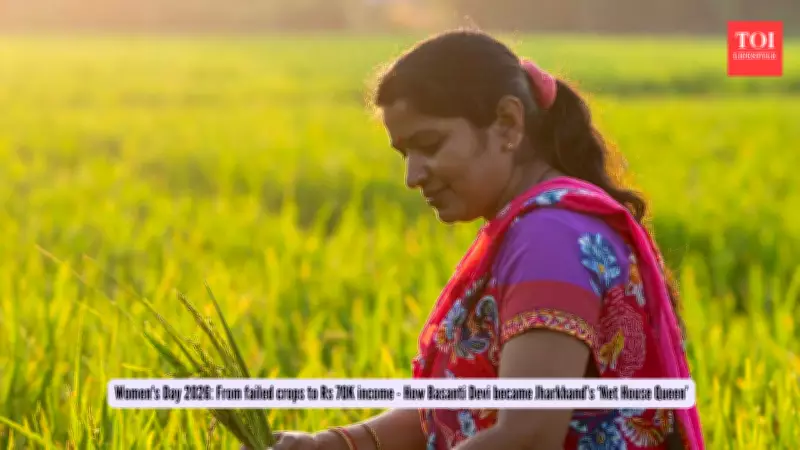
From Failed Crops to Rs 70K Income: How Basanti Devi Became Jharkhand's Net House Queen
Women today are breaking barriers and excelling in every sphere of life, from corporate boardrooms to homesteads and agricultural fields. Their stories of resilience and determination serve as powerful inspirations, demonstrating how grit combined with smart technology can rewrite destinies. In the fertile lands of Jharkhand, where farmers once battled the whims of climate, innovation is now blooming, led by pioneers like Basanti Devi.
Meet Basanti Devi: The Farmer Who Defied Climate Odds
Basanti Devi is a 33-year-old farmer from Hesapora Tola in Shishatand-Gola village, located in Ramgarh district, Jharkhand. Her journey from struggle to success is a testament to perseverance and technological adoption. Last year, she achieved a significant milestone by upgrading from a mud house to a pakka makan (solid home), and her eldest son embarked on a BA degree program. According to reports from The Better India, these transformative changes are directly linked to her agricultural success, particularly through growing coriander off-season using a Kheyti Rakshak Net House.
Previously, Basanti faced repeated failures due to monsoon rains. "The heavy rains would damage the crop and wash it away, and all the money we spent on seeds would go to waste," she recounted to Better India. However, in 2023, with support from Transform Rural India (TRI) and guidance from Kheyti, the introduction of the net house revolutionized her farming practices.

Exceptional Outcomes: A Harvest of Prosperity
On October 16, 2025, Basanti planted 3 kg of high-quality coriander seeds, valued at Rs 900. Over eight harvest cuts, she yielded an impressive 85 kg of coriander, selling it at Rs 150 per kg and earning Rs 12,750 in that season alone. Now, her annual income has soared to approximately Rs 70,000, attracting curious women farmers to her 1.2-acre plot to learn from her success.
"The more I started seeing the results of growing these crops, the more I wanted to learn about the technology," Basanti shared with The Better India. Her commitment to innovation even led her to switch to a battery sprayer for enhanced efficiency in her farming operations.
The Unique Technique: Kheyti Rakshak Net House Explained
Before adopting the net house, Basanti struggled with water shortages and insect infestations that affected crops like peas, beans, tomatoes, and potatoes. "Either the availability of water used to be a problem for us, or the crops would get affected by insects. But even when the factors were in our favour, we were unable to earn throughout the year," she noted.
Bapi Gorai from TRI explained the benefits of the Kheyti Rakshak Net House to Better India: "The net house protects crops from harsh sunlight and reduces the temperature within by three to five degrees Celsius. It shields crops from high-speed winds of up to 100 kmph, unpredictable rains, and reduces pest infestations by up to 90 percent." This technology enables farmers to cultivate three to four crops annually, supported by free year-long agricultural advisory services.
The net house adapts to seasonal needs:
- From March to June, shade nets provide cooling for tomatoes and chillies.
- During monsoons, it protects beans and spinach from excessive rain.
- In winters, it creates ideal conditions for cabbage and strawberries.
A Beacon of Hope for Women Farmers
Basanti Devi's story is a shining example of how simple, tailored technology can transform climate threats into steady prosperity. Her success not only improved her family's livelihood but also inspired a wave of empowerment among women farmers in her community. As she continues to innovate and share her knowledge, Basanti stands as a symbol of resilience, proving that with the right tools and determination, even the most challenging agricultural landscapes can yield abundant harvests.






