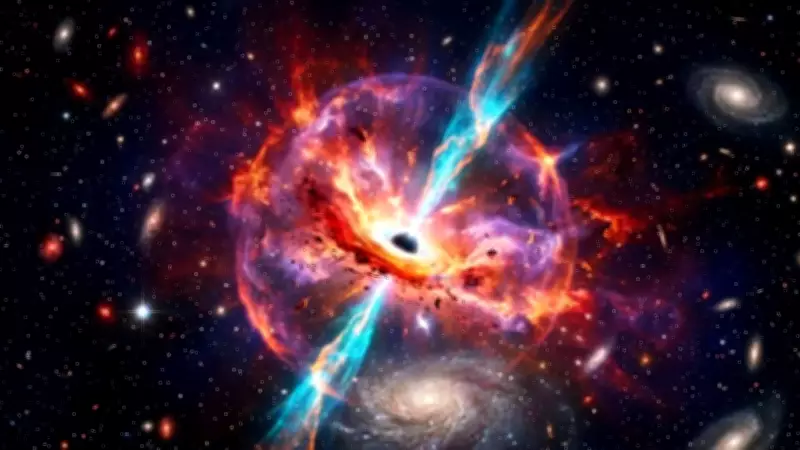
Scientists Stunned as Dormant Black Hole Awakens After 100 Million Years
In a groundbreaking discovery, astronomers have witnessed a supermassive black hole erupting with immense energy after lying dormant for approximately 100 million years. This event, likened to a cosmic volcanic eruption, challenges conventional views of the universe's tranquility and provides crucial data on the dynamic nature of black holes.
What Does It Mean for a Black Hole to "Wake Up"?
Black holes are not perpetually active; they can enter prolonged periods of inactivity when no matter is available for consumption. However, when gas, dust, or stars venture too close, these cosmic giants resume their feeding processes. The recent observation centers on a supermassive black hole at the heart of a distant galaxy, as detailed in the study 'The Clusters Hiding in Plain Sight (CHiPS) Survey: CHIPS1911+4455, a Rapidly Cooling Core in a Merging Cluster.' This research confirms that supermassive black holes can transition between dormant and active states.
Once activated, a black hole emits powerful bursts of energy and light. Scientists note that black holes can remain dormant for eons before suddenly becoming active due to the influx of new fuel, highlighting their cyclical behavior.

A Cosmic Volcano: Unpacking the Eruption
The analogy to a volcano stems from the way energy is discharged into space. Instead of lava, a black hole ejects high-energy jets and radiation. In this case, astronomers detected massive energy releases that likely built up over millions of years before erupting suddenly, similar to volcanic gases accumulating until they explode.
According to research papers from the National Aeronautics and Space Administration, active galactic nuclei can generate more energy than all the stars in a galaxy combined. This phenomenon significantly influences star formation and galactic structure, though unlike terrestrial volcanoes, it does not cause destruction but profoundly affects its cosmic surroundings.
Why This Discovery Is a Milestone in Astronomy
Firstly, this observation underscores the cyclical nature of black holes, which can lie inactive for millions of years before erupting again. Predicting such events could enhance our understanding of galaxy evolution.
Secondly, it highlights the vast unknowns in space. These rare occurrences, with their extremely long timescales, are difficult to observe but offer astronomers vital clues for further study.
Moreover, the finding supports theories on the interaction between black holes and their host galaxies, impacting gas clouds and star formation processes.
Lastly, while the volcanic comparison may seem exaggerated, it effectively illustrates the universe's immense activity. Investigating such eruptions helps unravel the fundamental mechanisms driving cosmic phenomena.